Fashion WMS India: Fix Stockouts and Picking Errors Across Stores
Table of Contents
- Introduction
- The Stockout and Picking Error Problem in Indian Fashion Retail
- What to Look for in a Fashion WMS for India
- Key Features of a Fashion Warehouse Management System
- How Commmerce Fixes Fashion Warehouse Chaos
- Conclusion
- FAQs
TL;DR
- Fashion WMS India solutions address the two biggest operational failures in multi-store fashion retail: stockouts caused by poor inventory visibility and picking errors caused by manual warehouse workflows.
- Indian fashion retailers with 2 to 50 stores need a WMS that is deeply integrated with their POS, OMS, and ecommerce channels so that stock, orders, and fulfilment stay in sync across every location.
- Commmerce is an Omnichannel Retail Operating System that includes native warehouse management, real-time multi-store inventory, barcode and RFID tracking, and GST-compliant billing in a single unified platform built specifically for Indian retailers.
- Switching from disconnected tools like Marg ERP or Vyapar to a unified omnichannel platform can dramatically reduce stockouts, picking errors, and delayed fulfilment across all channels.
Introduction
A reliable fashion WMS India solution is no longer a luxury for growing retailers. It is the operational backbone that separates fashion brands that scale smoothly across multiple stores from those that bleed revenue through stockouts, wrong shipments, and delayed deliveries. If your warehouse team is still working off printed picklists, and your store managers are calling each other to check stock availability, this post is for you.
Indian fashion retail is one of the most complex retail environments in the world. You are managing hundreds of SKUs across sizes, colours, and styles, across physical stores, your own website, and marketplaces like Myntra and Flipkart, all at the same time. A single warehouse picking error can trigger a return, a negative review, and a lost customer in one stroke.
This guide breaks down exactly why stockouts and picking errors happen in Indian fashion warehouses, what to look for in a warehouse management system built for the Indian retail context, and how a unified omnichannel platform can eliminate these problems at the root.
The Stockout and Picking Error Problem in Indian Fashion Retail
Stockouts and picking errors in Indian fashion retail are primarily caused by disconnected systems, not by a lack of stock. Most growing fashion retailers have the inventory. They just cannot see it, move it, or allocate it accurately across channels in real time.
Consider a fashion retailer with five stores across Delhi, Jaipur, and Lucknow. A customer places an order on the retailer's website for a kurta in size M, colour blue. The website shows it as available because the online catalogue was last synced two days ago. But that size and colour was sold in the Jaipur store yesterday morning. The order gets confirmed, the warehouse team picks a different size by mistake because the picklist is a printed sheet, and the customer receives the wrong item. This scenario plays out daily across thousands of Indian fashion businesses.
According to industry estimates, fashion retailers in India lose between 8 and 15 percent of potential revenue annually to stockouts and fulfilment errors. The India Brand Equity Foundation (IBEF) has consistently highlighted that the Indian retail sector is undergoing a rapid shift to omnichannel operations, and retailers who cannot manage inventory across channels in real time are at a structural disadvantage.
The root causes of these failures in fashion retail specifically include:
- No real-time stock sync between physical stores and the online store
- Manual picklists that do not verify item attributes like size and colour at the time of picking
- No branch-level inventory visibility, forcing managers to rely on phone calls and spreadsheets
- Disconnected tools like Tally, Marg ERP, or Vyapar that handle billing but offer no warehouse workflow
- No system to manage inter-branch stock transfers when one location runs out
- Returns processed manually, putting stock back into circulation without proper reconciliation
For a deeper look at how warehouse picking errors translate into direct revenue loss, read this guide on Warehouse Picking Errors Cost Indian Retailers 15%: WMS Solutions Guide.
⚠️Watch OutUsing separate tools for billing, inventory, and online orders without a unified sync layer is the single biggest cause of stockouts in multi-store fashion retail. The problem is not your stock levels. It is your data silos.
What to Look for in a Fashion WMS for India
The right warehouse management system for Indian fashion retail must do more than manage a single warehouse. It needs to connect every store, every channel, and every order into one real-time view of your inventory, from the moment stock arrives to the moment it reaches the customer.
Here is what separates a purpose-built fashion WMS India solution from a generic inventory tool or an accounting add-on:
Real-Time Multi-Store Inventory Visibility
Every SKU, including size and colour variants, must be visible across all store locations and warehouses from a single dashboard. When stock drops below a threshold at one branch, your system should alert you and allow immediate inter-branch transfer requests without any manual calls or emails.
Structured Picking, Packing, and Putaway Workflows
A proper WMS does not just track what you have. It guides your warehouse staff through what to do next. Picking workflows should use barcode or RFID scanning to verify that the correct item, correct size, and correct colour are being picked against the order. Packing workflows should enforce quality checks before dispatch. Putaway workflows should ensure returns and new stock are correctly logged into the right bin or shelf location.
Barcode and RFID Based Tracking
Fashion retail has one of the highest SKU densities of any category. A white kurta in size S and a white kurta in size M look identical to the human eye. Barcode scanning at the item level eliminates visual picking errors entirely. RFID further speeds this up for high-volume fashion warehouses where scanning individual items is time-consuming.
Integration with Your Online Store and Marketplaces
Your WMS cannot operate in isolation. It must push stock level updates to your online store and any marketplace listings in real time. When a size sells in-store, the online catalogue must reflect that immediately. This prevents overselling, which is one of the costliest problems in fashion ecommerce for Indian retailers.
GST-Compliant Stock and Transfer Documentation
Every inter-branch stock transfer in India requires proper documentation for GST purposes. Your WMS must generate GST-compliant transfer notes and e-way bills automatically, without your team having to manually create these in a separate accounting tool. The GSTN e-invoice portal mandates e-invoicing for businesses above a specified turnover threshold, and your WMS workflows should integrate with this seamlessly.
For a broader look at omnichannel strategies that prevent stockouts before they happen, read: Fashion Retailers: Prevent Stockouts with Omnichannel Strategies 2026.
💡Pro TipBefore evaluating any WMS, map out every touchpoint where stock can enter or leave your business - store sales, online orders, returns, inter-branch transfers, supplier deliveries - and make sure your WMS covers all of them with a structured workflow, not just a count update.
Key Features of a Fashion Warehouse Management System
A best-in-class fashion warehouse management system for Indian multi-store retailers should include the following capabilities. Use this as a checklist when evaluating any platform.
Centralised Inventory Dashboard Across All Branches
Your head office team should be able to see stock levels at every store and warehouse in real time from a single screen. This includes stock on hand, stock in transit, and stock reserved for pending orders. Without this, your buying and replenishment decisions are always based on stale data.
Guided Picking with Scan-and-Verify
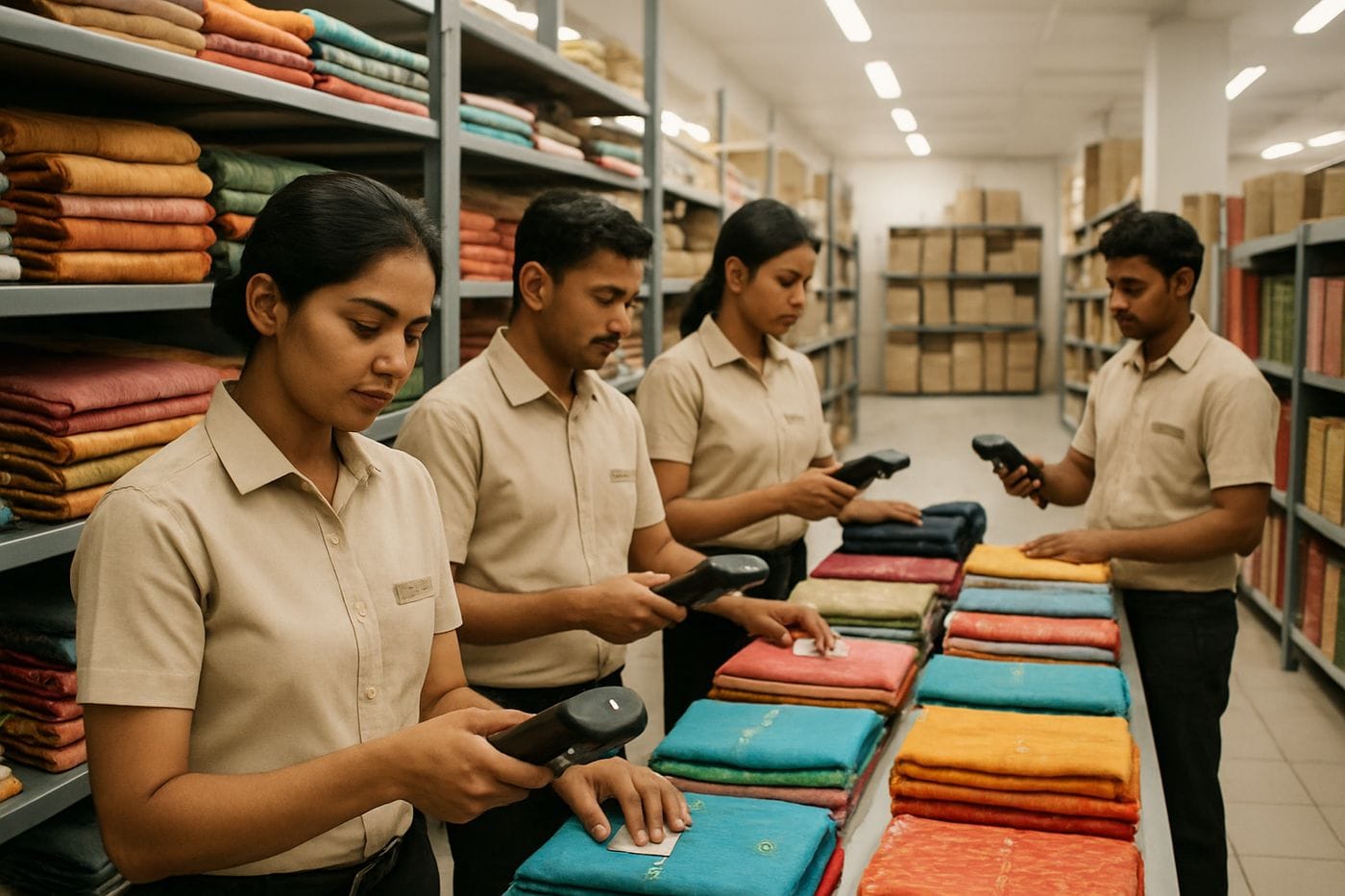
Each picking task should be assigned to a staff member through the system. The staff member scans the barcode of each item before placing it in the pick bin, and the system verifies it matches the order line. If there is a mismatch, the system flags it immediately. This single feature alone can eliminate the majority of picking errors in a fashion warehouse.
Automated Reorder and Replenishment Triggers
When stock at a branch or warehouse falls below a predefined minimum, the system should automatically raise a transfer request from the nearest available location or a purchase order to the supplier. This is what prevents stockouts from happening in the first place, rather than discovering them after a sale is lost.
Returns Management with Stock Reconciliation
Returns are extremely common in fashion retail, both from physical stores and from online orders. Your WMS must handle returns with a structured workflow: inspect the item, classify it as sellable or damaged, and log it back into the correct inventory location. Manual returns management is one of the biggest sources of phantom stock in Indian fashion retail.
Multi-Channel Order Routing and Fulfilment Logic
When an order comes in from your website, WhatsApp, or a marketplace, your system should automatically identify which store or warehouse has the stock and route the fulfilment request there. This is omnichannel order management working in tandem with your WMS, and it is what allows you to fulfil from the closest or most stocked location rather than always routing everything through a central warehouse.
Also see: Reducing Stockouts in 2026: Omnichannel Tips for Indian Fashion Stores for practical strategies that complement your WMS implementation.
How Traditional Tools Compare to a Dedicated Fashion WMS
| Capability | Marg ERP / Vyapar / TallyPrime | Commmerce Omnichannel OS |
|---|---|---|
| Real-time multi-store inventory | No (batch sync or manual) | Yes, real-time across all branches |
| Guided picking with barcode scan | No | Yes, with scan-and-verify workflow |
| Online store stock sync | Not available natively | Yes, built-in ecommerce storefront |
| Omnichannel order routing | No | Yes, via built-in OMS |
| GST e-invoice integration | Partial (billing only) | Yes, fully integrated with GSTN |
| Returns management with reconciliation | Manual | Structured workflow with stock update |
Marg ERP, Vyapar, and TallyPrime are useful accounting and billing tools, but they were not designed to manage the physical movement of stock across multiple store locations or to sync inventory across online and offline channels in real time. As your fashion business grows beyond two or three stores, the gaps in these tools become the primary source of operational errors.
For a detailed breakdown of warehouse management specifically for Indian fashion retailers, read: Warehouse Management for Indian Fashion Retailers: Cut Stockouts 60%.
How Commmerce Fixes Fashion Warehouse Chaos
Commmerce is an Omnichannel Retail Operating System built specifically for Indian retailers with 2 to 50 stores. It brings your physical stores, online store, warehouses, and order management into a single unified platform, so you never have to reconcile data between disconnected tools again.
Here is how Commmerce directly addresses the fashion WMS India challenges described above:
Native Warehouse Management with Picking, Packing, and Putaway
Commmerce includes structured warehouse workflows built into the platform. Your staff receive digital picking tasks on their devices, scan barcodes to verify each item, and the system confirms or flags mismatches instantly. Putaway workflows ensure returned and inbound stock is logged correctly into the right location. There are no paper-based processes that create room for human error.
Real-Time Centralised Inventory Across All Stores
Every sale at every store, every online order fulfilled, every inter-branch transfer, and every return is reflected in your central inventory count in real time. Your head office team sees exactly what is available at each branch at any given moment, and your online store always shows accurate stock levels. This is the foundation that prevents both stockouts and overselling.
Barcode and RFID Inventory Tracking
For fashion retailers managing thousands of size and colour variants, Commmerce supports both barcode and RFID-based inventory tracking. This means your team can do rapid stock counts, cycle counts, and picking verification without slowing down operations or relying on visual identification of items that look nearly identical.
Built-In OMS for Multi-Channel Order Routing
Commmerce's Order Management System automatically routes incoming orders from your online store, WhatsApp, or any marketplace to the branch or warehouse with available stock. The OMS applies configurable routing logic so fulfilment always comes from the most efficient location, reducing both delivery time and the risk of promising stock that does not actually exist.
Offline-First POS That Never Goes Down
Fashion stores in tier-2 and tier-3 cities often face unreliable internet connectivity. Commmerce's POS operates fully offline and syncs all transactions automatically when the connection is restored. Your billing never stops, and your inventory counts are always reconciled once connectivity returns.
GST-Compliant Billing and e-Invoice Generation
Commmerce includes built-in GST billing and e-invoice generation that integrates directly with the GSTN e-invoice portal. Every sale, transfer, and return generates the correct tax documentation automatically, so your finance team is not manually reconciling billing records at month end.
Logistics Integrations for Last-Mile Delivery
Once an order is picked and packed, Commmerce connects directly with logistics partners including Delhivery, Shiprocket, and Ecom Express to generate shipping labels and track delivery status. Your warehouse team does not need to log into a separate courier portal. Everything happens inside the same platform.
Read more about how fashion retailers are using omnichannel operations to reduce stockouts: How Fashion Retailers Can Reduce Stockouts With Omnichannel Ops.
Running a fashion retail business in India? See how Commmerce unifies your stores, inventory, warehouse, and delivery in one omnichannel platform built for Indian retailers.
The Retailers Association of India (RAI) has noted that Indian retailers who invest in unified technology platforms see significantly better inventory accuracy and customer satisfaction scores compared to those running on fragmented systems. Commmerce is designed to be that unified platform for fashion retailers at every stage of growth.
Commmerce also provides a local support team that understands the specific challenges of Indian retail, from GST compliance to the nuances of regional buying patterns and logistics connectivity. This matters because the issues you face in a Jaipur fashion warehouse are different from those in a Mumbai one, and your technology partner needs to understand that.
.
Conclusion
For Indian fashion retailers managing multiple stores and channels, implementing a capable fashion WMS India solution is the most direct path to eliminating stockouts and picking errors. The core problem is almost never a shortage of physical stock. It is a shortage of real-time visibility, structured warehouse workflows, and cross-channel inventory sync. Tools like Marg ERP, Vyapar, and TallyPrime were built for accounting and billing, not for the operational complexity of multi-store, multi-channel fashion retail. A purpose-built Omnichannel Retail Operating System that integrates warehouse management, OMS, ecommerce, and GST-compliant billing into one platform gives fashion retailers the infrastructure to grow without growing their operational problems alongside them. The retailers who fix their warehouse operations today are the ones who will fulfil faster, lose less to errors, and build stronger customer loyalty across every channel they operate.
FAQs
Q: What is a Fashion WMS and why do Indian retailers need one?
A: A Fashion WMS (Warehouse Management System) is software that manages picking, packing, putaway, and inventory tracking inside a warehouse or retail store. Indian fashion retailers with multiple stores need one because manual stock management leads to stockouts, picking errors, and lost sales across branches.
Q: How does a WMS reduce picking errors in fashion retail?
A: A WMS reduces picking errors by using barcode or RFID scanning to verify each item picked against the order, eliminating reliance on manual memory or paper-based picklists, which are the most common source of wrong shipments in fashion retail.
Q: Can a Fashion WMS work across multiple store locations in India?
A: Yes, a multi-store Fashion WMS centralises inventory across all branches and warehouses in real time, so stock levels, transfers, and order fulfilment are always accurate regardless of how many locations a retailer operates.
Q: How is Commmerce different from Marg ERP or Vyapar for fashion warehouse management?
A: Commmerce is a full Omnichannel Retail Operating System that includes native warehouse management with picking, packing, and putaway workflows, real-time multi-store inventory, and channel-level order routing, whereas Marg ERP and Vyapar are primarily accounting or billing tools without dedicated WMS or omnichannel capabilities.
Q: Does Commmerce's WMS support GST-compliant e-invoicing for fashion retailers?
A: Yes, Commmerce includes built-in GST billing and e-invoice generation that is compliant with Indian tax laws, integrated directly with its warehouse and order management workflows so invoices are generated automatically at the point of fulfilment.
Disclaimer: This article is for general informational purposes only and does not constitute legal, financial, or tax advice. GST rules, compliance requirements, and platform features may change over time. Please verify the latest guidelines with a qualified professional or refer to official sources such as the GSTN or CBIC. Market statistics mentioned are based on publicly available estimates and may not reflect current figures. Commmerce product features referenced are accurate at the time of writing and subject to change.