How Indian Kirana Stores Cut Dead Stock with Demand Forecasting
Table of Contents
- Introduction
- The Dead Stock Problem Indian Kirana Stores Face
- The Solution: What to Look for in a Demand Forecasting Approach
- How to Implement Demand Forecasting in Your Kirana Store
- How Commmerce Helps Kirana Retailers Reduce Dead Stock
- Conclusion
- FAQs
TL;DR
- Indian kirana stores lose significant working capital every year to dead stock caused by manual, gut-feel purchasing with no data to back it up.
- Demand forecasting using real sales history, seasonal patterns, and category trends helps kirana retailers order the right quantity at the right time.
- A unified omnichannel retail platform like Commmerce gives kirana stores real-time inventory visibility and sales analytics across all channels, replacing disconnected tools like Vyapar or Excel.
- Commmerce runs on existing Android or iOS devices with no hardware investment, so even small neighbourhood stores can get started without disruption.
Introduction
How Indian kirana stores cut dead stock with demand forecasting is one of the most practical questions facing neighbourhood retailers in 2026. The corner grocery shop has always operated on intuition, supplier relationships, and years of experience. But as margins tighten, competition from quick-commerce apps intensifies, and consumer preferences shift faster than ever, that intuition alone is no longer enough to protect profitability.
Dead stock, which is inventory that sits on shelves unsold past its useful life, is quietly draining the working capital of thousands of kirana stores across India. The good news is that demand forecasting, once the exclusive domain of large supermarket chains, is now accessible to independent retailers through affordable modern technology. This guide breaks down what dead stock costs you, how smarter inventory forecasting works, and how platforms built specifically for Indian retail can help you stock smarter without overhauling your entire operation.
The Dead Stock Problem Indian Kirana Stores Face
Dead stock in kirana stores is the result of ordering more than customers actually buy, and it is far more common than most store owners realise. Unsold inventory ties up cash, wastes shelf space, and eventually has to be sold at a loss or discarded entirely, especially in categories like perishables, personal care, or seasonal items.
Most kirana retailers in India still manage purchasing through a combination of memory, handwritten registers, or at best a basic billing app like Vyapar or Marg ERP. These tools record what was sold after the fact, but they offer no forward-looking intelligence. There is no signal telling a retailer that masala brand X sells 40% more in October due to the festive season, or that a new competitor opening nearby has shifted demand for a particular SKU.
According to industry estimates, a significant portion of small retailer working capital in India is locked in slow-moving or non-moving stock at any given time. The India Brand Equity Foundation notes that Indian retail is one of the fastest-growing sectors in the country, yet operational inefficiency remains a key challenge for unorganised and semi-organised retailers.
The core pain points are consistent across kirana stores of different sizes:
- No real-time visibility into which SKUs are moving slowly before they become dead stock
- Manual reorder decisions based on supplier push rather than customer pull
- No way to track sales velocity by product, category, or time period
- No unified view when the same retailer also sells through WhatsApp or an online storefront
- Returns and near-expiry items managed informally, with no system to flag them early
The result is a cycle of over-ordering popular-sounding products, under-ordering fast movers, and accumulating dead stock that slowly erodes margin. For a store doing ₹20 to ₹80 lakh in annual revenue, even a 5% improvement in inventory efficiency can mean lakhs of rupees freed up for reinvestment.
⚠️Watch OutRelying on supplier recommendations alone to decide reorder quantities is one of the most common reasons kirana stores accumulate dead stock. Suppliers are incentivised to push volume, not to optimise your shelf productivity.
The Solution: What to Look for in a Demand Forecasting Approach
Demand forecasting for kirana stores means using actual sales data to predict future purchase volumes, so you order the right quantity at the right time rather than guessing. The best approach combines historical sales patterns, seasonal trends, and category-level insights to give you a reliable reorder baseline.
When evaluating any inventory management approach or retail technology platform, kirana retailers should look for these capabilities:
Sales History Tracking at the SKU Level
Any effective demand forecasting method starts with clean, consistent sales data at the product level. This means every sale, return, and wastage event should be recorded digitally in real time, not summarised in a weekly register entry. A system that tracks sales velocity per SKU gives you the raw material for forecasting.
Platforms like TallyPrime or basic versions of Marg ERP can capture some sales data, but they are designed primarily for accounting and tax compliance. They do not surface inventory intelligence in a way that helps you make faster restocking decisions across multiple suppliers and hundreds of SKUs simultaneously.
Seasonal and Event-Based Demand Patterns
Indian retail demand is highly seasonal and deeply tied to local festivals, regional events, and even weather cycles. A kirana store in Pune will see different festive demand spikes than one in Lucknow. Any intelligent forecasting approach must account for this variability. Look for a platform that lets you compare sales across equivalent periods, such as Diwali week this year versus last year, so you can calibrate your orders accordingly.
Slow-Mover and Dead Stock Alerts
Rather than waiting for a product to expire or become unsellable, a good inventory system should proactively flag items that are moving below a defined velocity threshold. This gives you time to act, whether by running a promotion, returning stock to the supplier, or bundling slow movers with fast sellers. For perishables and FMCG products, early detection is the difference between a markdown and a write-off.
You can read more about how this applies specifically to grocery retail in this detailed guide on How Indian Grocery Chains Can Cut Dead Stock with Demand Forecasting.
Centralised Inventory Across All Sales Channels
Many kirana stores today are not purely walk-in stores. They take orders on WhatsApp, deliver locally, and some have launched basic online storefronts. If your inventory is not centralised across all these channels, you will oversell on one channel and accumulate dead stock on another because you cannot see the full picture. Real-time multi-channel inventory visibility is non-negotiable for accurate demand forecasting.
💡Pro TipBefore investing in any technology, audit your top 50 SKUs by sales velocity for the last 90 days. The gap between your highest and lowest performers will tell you exactly how much dead stock risk you are carrying right now.
How to Implement Demand Forecasting in Your Kirana Store
Implementing demand forecasting in a kirana store does not require a data science team or expensive enterprise software. It requires a structured approach to capturing sales data and using it consistently to guide purchasing decisions. Follow these steps to get started.
- Digitise your sales recording immediately. Every billing transaction should be captured in a digital system that records the SKU, quantity, time, and channel. If you are still using a handwritten khata or a basic billing app that does not sync across channels, this is your starting point. Without clean sales data, no forecasting is possible.
- Categorise your inventory by movement speed. Separate your products into fast movers (sold every day), medium movers (sold weekly), and slow movers or seasonal items (sold monthly or less). This ABC classification helps you apply different reorder rules to different segments rather than treating every SKU the same way.
- Set reorder points based on actual sales velocity, not supplier minimums. For each product, calculate a reorder point using average daily sales multiplied by your supplier lead time. Add a safety stock buffer for your highest-velocity items. This prevents both stockouts on bestsellers and over-ordering on slow movers.
- Review slow-mover reports every week. Use your inventory management platform to pull a weekly report of items that have not sold in the past 21 days. For each flagged item, decide on a clear action: discount, bundle promotion, supplier return, or discontinue. Taking action early is what separates smart kirana operators from those who discover dead stock only when it expires.
- Compare demand across equivalent seasonal periods. Before placing festive orders or monsoon stock-ups, compare your sales data from the same period in the previous year. Adjust for any store growth or new competitors and use that as your order baseline rather than guessing or accepting the supplier's suggested quantity.
- Monitor channel-wise sell-through for multi-channel sellers. If you sell via walk-in, WhatsApp, and an online storefront, track which channel is moving which SKU. Products that sell online may need different stock allocation than those that move in-store. A unified platform makes this visible without manual reconciliation.
For a deeper look at how receiving errors at the warehouse level contribute to dead stock before products even reach the shelf, this resource on Warehouse Receiving Errors: Fix Dead Stock in Indian Grocery Chains is worth reading alongside this guide.
According to the Department of Consumer Affairs, Government of India, perishable goods management and supply chain efficiency remain core priorities for Indian food retail, underscoring why systematic forecasting matters even at the neighbourhood store level.
Comparing Manual Methods to a Unified Platform
| Criteria | Manual / Basic Billing App | Unified Omnichannel Platform |
|---|---|---|
| Sales data visibility | End-of-day manual tallying | Real-time across all channels |
| Slow-mover detection | Only when stock is noticed physically | Automated reports by velocity threshold |
| Multi-channel inventory sync | Not available, manual reconciliation | Automatic, real-time sync |
| Seasonal comparison reports | Manual Excel comparisons, error-prone | Built-in period-on-period analytics |
| GST compliance | Separate filing, manual errors common | Built-in GST billing and e-invoice generation |
How Commmerce Helps Kirana Retailers Reduce Dead Stock
Commmerce is an Omnichannel Retail Operating System built specifically for Indian retailers, and it addresses the dead stock problem at every layer: from how sales are captured at the point of billing, to how inventory is tracked across channels, to how orders are routed and fulfilled.
Unlike tools such as Vyapar or Marg ERP that handle billing and basic accounting in isolation, Commmerce connects POS, inventory management, online store, order management, and delivery into a single platform. This means a kirana retailer using Commmerce has one version of the truth about their stock at all times, whether a customer walks in, orders on WhatsApp, or buys from the store's online storefront.
Real-Time Inventory Visibility Across All Sales Points
Commmerce provides centralised inventory management across multiple branches and warehouses in real time. For a kirana store with even one additional outlet or a small storage room, this eliminates the guesswork about where stock actually is. Every sale, whether billed through the POS or fulfilled through an online order, immediately updates the inventory count. This is the foundational layer that makes demand forecasting for kirana stores meaningful rather than theoretical.
Offline-First POS That Never Loses a Sale
Commmerce's POS is offline-first, meaning it continues to operate without an internet connection and syncs automatically when connectivity is restored. For kirana stores in areas with inconsistent connectivity, this means billing never stops during peak hours and no sales data is lost. Continuous, unbroken sales data is what makes inventory analytics reliable over time.
Barcode and RFID-Based Inventory Tracking
Commmerce supports barcode and RFID-based inventory tracking, which brings systematic, accurate stock counting to even a neighbourhood kirana store. Instead of estimating stock levels by eye or doing monthly manual counts, every product movement is tracked at the unit level. This dramatically improves the accuracy of any slow-mover or dead stock analysis.
Real-Time Sales Analytics and Reports
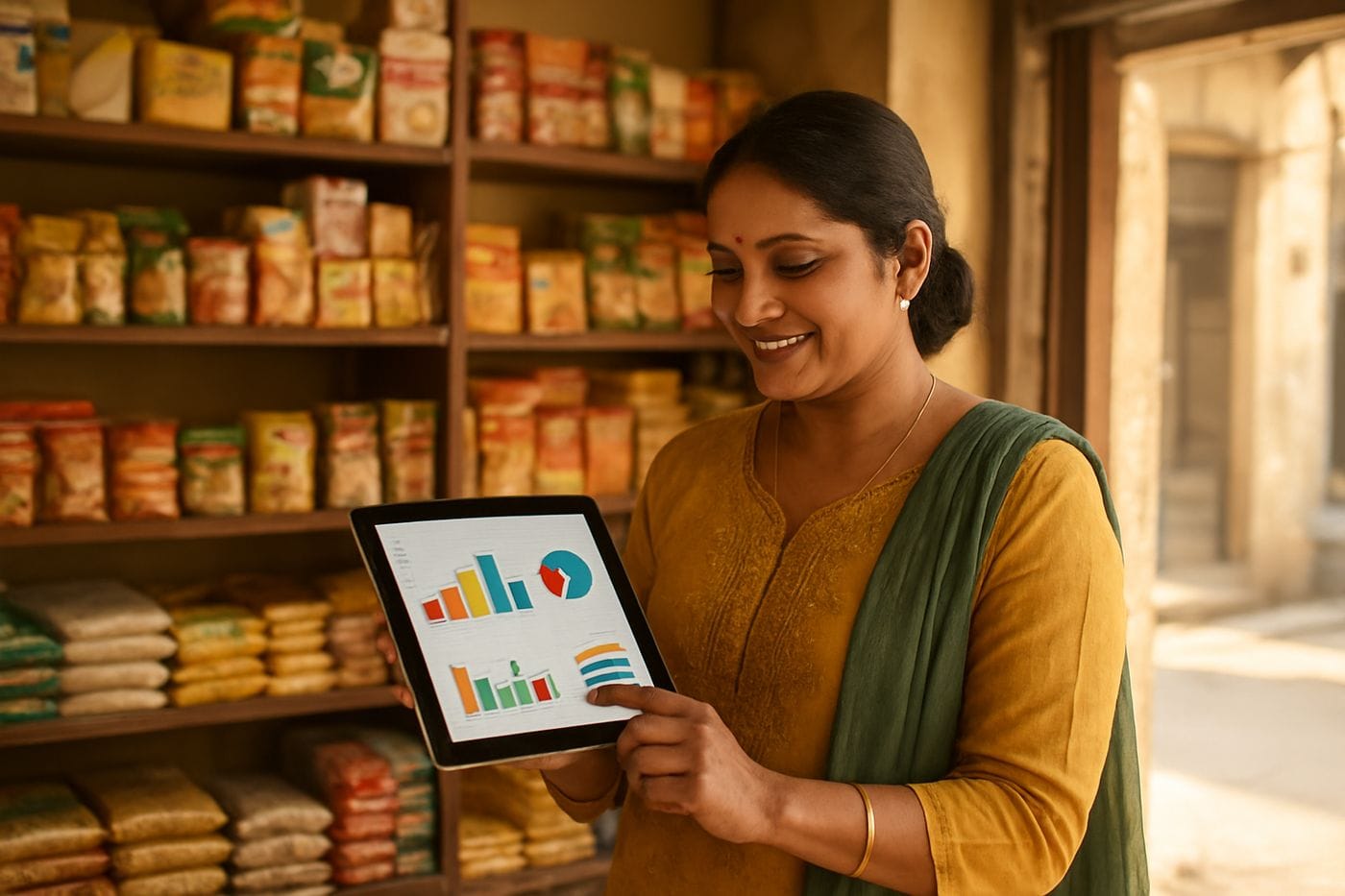
Commmerce provides real-time sales analytics and reports across all stores. Kirana retailers can see which SKUs are moving, which are stagnating, and how performance compares across time periods, which is exactly the data needed to calibrate purchase orders and prevent dead stock from building up. This replaces the manual Excel tracking that most independent retailers currently rely on.
Built for India from Day One
Commmerce includes built-in GST billing and e-invoice generation compliant with Indian tax laws, native integrations with payment platforms including Razorpay, PhonePe, and Paytm, and logistics integrations with Delhivery, Shiprocket, and Ecom Express. These are not add-ons; they are part of the core platform. For a kirana retailer who is also handling local deliveries, this means the entire operation, from billing to dispatch, runs in one place.
Runs on Your Existing Hardware
One of the most important practical advantages of Commmerce for kirana stores is that it runs on Windows, Mac, Android, and iOS, on affordable generic hardware. There is no need to buy proprietary billing terminals or replace existing smartphones and tablets. It installs on existing devices with no hardware or data migration required, meaning a store can go live quickly without any upfront capital expenditure on hardware.
Running a kirana or grocery retail business in India? See how Commmerce unifies your stores, inventory, orders, and delivery in one platform so you can stop guessing and start forecasting.
Conclusion
Cutting dead stock with demand forecasting is no longer a capability reserved for large supermarket chains. Indian kirana stores that move from gut-feel purchasing to data-driven inventory decisions can free up meaningful working capital, reduce wastage, and stock shelves with products that customers actually want to buy. The foundation is simple: digitise your sales data, track inventory in real time, identify slow movers early, and use historical patterns to guide your orders. Tools that handle billing in isolation, like Vyapar or Marg ERP, do not provide the connected, real-time view needed for effective demand forecasting for kirana stores. A unified omnichannel retail platform that connects POS, inventory, and order management in one place gives neighbourhood retailers the visibility and control to reduce dead stock systematically, without expensive hardware or complex migrations.
FAQs
Q: What is demand forecasting for kirana stores?
A: Demand forecasting for kirana stores means using historical sales data, seasonal trends, and customer purchase patterns to predict how much stock to order, so shelves stay full without excess inventory piling up as dead stock.
Q: How does dead stock hurt a kirana store's profitability?
A: Dead stock ties up working capital that could be reinvested in faster-moving products, occupies shelf space, and often expires or goes out of season before it can be sold, directly reducing a kirana store's net margin.
Q: Can a small kirana store use demand forecasting without expensive software?
A: Yes, modern omnichannel retail platforms like Commmerce run on affordable generic hardware including Android smartphones and tablets, so even a small kirana store can access real-time sales analytics and inventory insights without investing in expensive proprietary terminals.
Q: How is Commmerce different from Vyapar or Marg ERP for inventory management?
A: Unlike Vyapar or Marg ERP, which handle billing and basic accounting in isolation, Commmerce is a full Omnichannel Retail Operating System that connects POS, inventory, online store, order management, and delivery into one unified platform, giving retailers real-time stock visibility across all channels.
Q: How quickly can a kirana store go live on Commmerce?
A: Commmerce installs on existing devices with no hardware replacement or data migration required, so a kirana store can go live quickly without any downtime or large upfront hardware investment.
Disclaimer: This article is for general informational purposes only and does not constitute legal, financial, or tax advice. GST rules, compliance requirements, and platform features may change over time. Please verify the latest guidelines with a qualified professional or refer to official sources such as the GSTN or CBIC. Market statistics mentioned are based on publicly available estimates and may not reflect current figures. Commmerce product features referenced are accurate at the time of writing and subject to change.