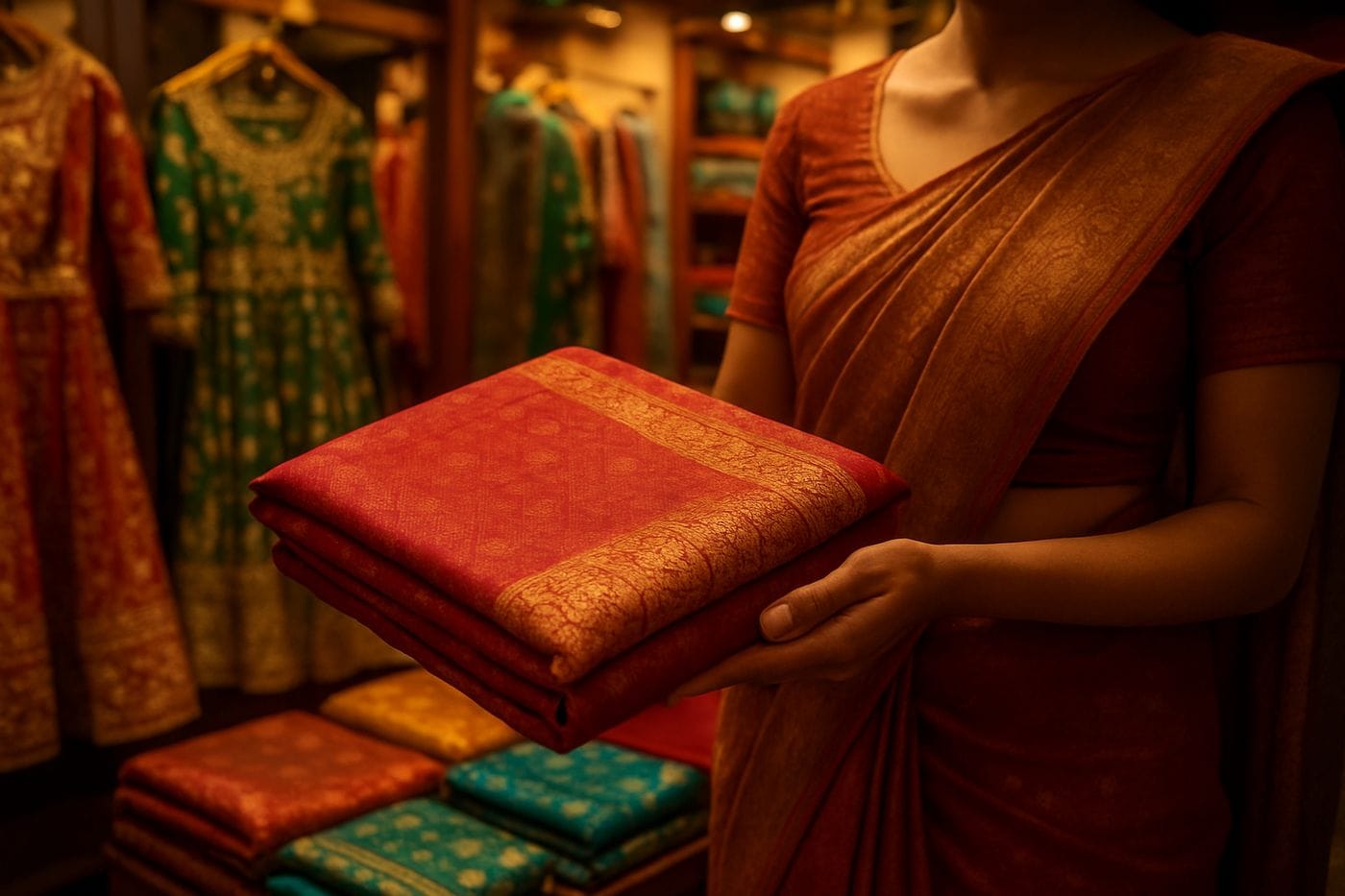
How Indian Ethnic Wear Stores Fix Dead Stock With Omnichannel OMS
Table of Contents
- Introduction
- The Dead Stock Problem in Indian Ethnic Wear Retail
- What to Look for in an OMS for Ethnic Wear Dead Stock
- How to Fix Dead Stock With an Omnichannel OMS: Step by Step
- Key OMS Features That Clear Dead Stock Faster
- How Commmerce Helps Ethnic Wear Retailers
- Conclusion
- FAQs
TL;DR
- Indian ethnic wear stores accumulate dead stock because inventory is siloed across physical stores and online channels, making slow-moving pieces invisible until it is too late.
- An omnichannel OMS for ethnic wear dead stock management creates a single live inventory ledger across every channel, so slow-moving SKUs can be surfaced, re-routed, or put on clearance before the season ends.
- Commmerce OMS connects in-store POS, your own website, and marketplaces like Amazon India and Flipkart into one order queue, with stock syncing across all channels within 30 seconds.
- Retailers go live on Commmerce OMS in one to five days, with no new hardware and no lengthy migration.
Introduction
For Indian ethnic wear stores, fixing dead stock with an omnichannel OMS has moved from a nice-to-have to an urgent operational priority. Every festive season, racks fill with lehengas, sarees, and kurtas bought in anticipation of demand that does not always arrive in the right size, the right colour, or at the right location. What is left behind is capital frozen in fabric, occupying floor space and warehouse shelves for months after Navratri or Diwali has passed.
The problem is not that ethnic wear retailers make bad buying decisions. It is that they make those decisions with incomplete information, and then manage the consequences on disconnected systems that never talk to each other. This guide explains why that happens, what an omnichannel order management system actually does to solve it, and how Indian ethnic wear businesses can go from siloed chaos to a single, live view of every order and every unit of stock.
The Dead Stock Problem in Indian Ethnic Wear Retail
Dead stock in ethnic wear retail is a structural problem, not a one-off buying mistake. It exists because the way most Indian retailers manage inventory across channels creates the conditions for stock to get stranded.
Consider a mid-sized ethnic wear chain with three physical stores in a city and a presence on Myntra, a Shopify store, and an Instagram page that takes WhatsApp orders. Each of those channels runs its own stock count. The Shopify store has a number. The billing software at each store has a different number. The Myntra seller panel has whatever was last updated manually. None of them agree.
When a Kanjivaram saree in size medium sits unsold at the Andheri store for six weeks, the Bandra store is out of stock in the same variant and turning away walk-in customers. The online store could sell it too, but nobody has pushed that stock online because the process is manual and time-consuming. By the time someone notices the mismatch, the wedding season window has closed and the saree joins the dead stock pile.
This is the core failure: siloed inventory data means slow-moving stock stays invisible until it is too late to act on it. According to industry estimates, dead stock and unsold inventory represent one of the top three working capital drains for Indian apparel retailers, particularly in categories with strong seasonal and occasion-led demand cycles like ethnic wear.
Tools like Tally, Marg ERP, and Vyapar are built for accounting and basic billing. They are not designed to give a retailer a live, unified view of stock across physical and digital channels. That gap is exactly what an omnichannel OMS is built to close. You can read more about how these operational gaps affect Indian retailers in The Complete Guide to Omnichannel Retail for Indian Businesses.
⚠️Watch OutRunning clearance sales on a single channel while other channels still show the same stock as available almost always leads to overselling, which creates refunds, negative reviews, and courier return costs that eat directly into your clearance margin.
What to Look for in an OMS for Ethnic Wear Dead Stock
The right omnichannel OMS for managing ethnic wear dead stock does one foundational thing above all else: it makes the inventory ledger the single source of truth for every channel simultaneously, so no channel ever works off a stale or incorrect stock count.
Beyond that core requirement, ethnic wear retailers should look for the following when evaluating order management systems built for Indian retail dead stock reduction:
- Real-time multi-channel inventory sync. Stock changes should reach every connected channel within seconds, not hours. If you mark a lehenga as on clearance at your store, your website and marketplace listings should reflect the updated available quantity almost immediately.
- Atomic reservation to prevent overselling. During a clearance sale, two channels should not be able to sell the last available unit simultaneously. This requires row-level locking at the inventory ledger, not just a polling sync.
- Unified order queue across all channels. Marketplace orders, website orders, and walk-in POS orders should land in one queue so your team can prioritise fulfilment based on SLA deadlines, not which portal they remembered to check.
- Smart order routing. When a customer orders online, the OMS should be able to route that order to the store or warehouse holding the stock, not just to a central warehouse that may be out of that variant.
- NDR handling for COD orders. Ethnic wear has a high COD rate. Failed deliveries on clearance stock that go unactioned waste the recovery window and push units back into dead stock. Look for an OMS that treats NDR as a first-class operational flow with a defined action window.
- GST e-invoicing integration. Any clearance or bulk sale needs compliant invoicing. The OMS should handle GST e-invoicing natively so your team does not manage it separately. The GSTN e-invoice portal mandates e-invoicing for eligible turnover thresholds, and your OMS should stay compliant automatically.
For a deeper look at how inventory strategy and channel coordination interact in Indian retail, see 2026 Omnichannel Retail Strategies: Cutting Stock Mismatch in India.
💡Pro TipBefore evaluating any OMS, map every place your ethnic wear inventory currently lives: billing software, marketplace seller panels, WhatsApp notes, spreadsheets. The number of disconnected systems you find is exactly the number of stock reconciliation errors your team is absorbing every week.
How to Fix Dead Stock With an Omnichannel OMS: Step by Step
Fixing dead stock with an omnichannel OMS is a structured process that starts with getting all your inventory onto one ledger and ends with every channel automatically reflecting accurate, real-time stock without manual updates.
- Audit and consolidate your current inventory. Before connecting any channel, do a physical count and reconcile it. This is the starting truth your OMS will maintain. For ethnic wear, this means cataloguing by SKU at the variant level: style, colour, size, and fabric. The more granular your catalogue, the more accurately the OMS can surface slow-moving variants.
- Connect all your sales channels to the OMS. Connect your in-store POS, your Shopify or WooCommerce website, and your marketplace accounts on Amazon India and Flipkart. A modern omnichannel OMS handles all of these through its own connectors, so your channels send orders into the OMS and read available stock out of it. Channels stop owning inventory the moment they connect.
- Let the OMS take over as the single inventory source. Once connected, the OMS becomes the canonical ledger. Every sale on any channel deducts from this central count. Every return adds back to it. Your team stops updating stock manually on each platform, because the OMS pushes the correct available quantity to all channels automatically, within 30 seconds of any change.
- Use the unified order queue to prioritise slow-moving stock fulfilment. With all orders in one place, your operations team can see which store or warehouse is holding dead stock and route orders there first. If a customer in Pune orders a kurta that is dead stock at your Delhi warehouse, the routing engine can fulfil from Delhi rather than your Mumbai store that could sell it locally.
- Run clearance campaigns across all channels simultaneously. With a single inventory ledger, you can mark dead stock variants for clearance on every channel at once, confident that the OMS will prevent overselling through atomic reservation. Two channels physically cannot both sell the last unit.
- Monitor and act on NDR for COD clearance orders. When a clearance COD order fails delivery, you have a 24 to 48 hour window to act before the courier auto-returns it. Use the OMS's NDR management flow to reattempt, update the address, or offer a prepaid switch before the unit comes back into dead stock.
Key OMS Features That Clear Dead Stock Faster
An omnichannel OMS for ethnic wear dead stock management is only as useful as the specific features it brings to your operations. Here are the capabilities that make the most direct difference for Indian ethnic wear retailers trying to move slow inventory.
One Live Inventory Ledger Across Every Channel
The foundational feature of any serious OMS for dead stock management is a canonical inventory ledger: one number per SKU, maintained centrally, pushed to every channel in real time. Without this, every channel operates on its own stale copy of stock, and dead inventory stays hidden in the gap between those copies. With it, your team can see at a glance which variants are moving and which have been sitting for 45 days, regardless of which channel or location they are in.
Atomic Reservation to Prevent Overselling During Clearance
Clearance sales drive a spike in simultaneous orders across channels. Without atomic reservation at the inventory row level, two customers on different channels can both receive a confirmation for the last available unit of a given lehenga. The resulting cancellations, refunds, and negative reviews cost more than the unit was worth. Atomic reservation means the OMS row-locks the inventory record the moment the first order claims it, making it physically impossible for a second channel to sell the same unit simultaneously.
Smart Routing Engine That Sends Orders to Dead Stock Locations
A routing engine that only looks at proximity or the central warehouse will not help you clear store-level dead stock. Look for a routing engine that considers stock availability at each location as a routing input, so online orders can be fulfilled from the store holding slow-moving inventory rather than always pulling from a central warehouse. This effectively turns your physical stores into dark store nodes that can help clear their own dead stock through online order fulfilment.
NDR Management as a Defined Recovery Flow
For an ethnic wear retailer with significant COD volume, NDR is not a rare edge case. It is a daily operational reality. An OMS that does not treat NDR as a first-class flow means your team is manually chasing courier portals to action failed deliveries, often missing the 24 to 48 hour window. A proper NDR flow adds a dedicated order state with a deadline, alerts your team automatically, and triggers auto-return if no action is taken, giving you a fighting chance to recover the sale before the unit comes back.
GST E-Invoicing and Tally Integration in the Order Flow
Any clearance or bulk order needs a valid GST invoice generated at the point of dispatch, not manually created later. An OMS with native GST e-invoicing keeps your compliance intact even during high-volume clearance periods, and Tally integration means your accounts team does not need to manually enter order data into a separate system. This is particularly relevant as IBEF's retail sector research highlights that compliance automation is one of the leading drivers of technology adoption among Indian mid-market retailers.
| Capability | Tally / Marg ERP / Vyapar | Commmerce Omnichannel OMS |
|---|---|---|
| Live inventory across all channels | No, each channel is separate | Yes, one canonical ledger |
| Atomic oversell prevention | No | Yes, row-level locking |
| Amazon India and Flipkart connector | No | Yes, both live |
| NDR management flow | No | Yes, 24 to 48 hour action window |
| GST e-invoicing in order flow | Partial, separate from order ops | Yes, integrated natively |
| Go-live time | Weeks to months | 1 to 5 days |
Channel Sync Within 30 Seconds, Including Peak Events
During a festive season clearance, stock moves fast. An OMS that syncs inventory every few hours is useless for preventing overselling or keeping marketplace listings accurate. The sync service needs to push available quantity updates to every connected channel within 30 seconds of any stock change, including during high-volume sale events where multiple orders arrive simultaneously. This is particularly relevant for ethnic wear retailers running Big Billion Day or Great Indian Festival clearance campaigns on Amazon and Flipkart at the same time as their own website sale.
The lessons from adjacent categories apply directly here. See how Indian footwear chains cut stockouts with omnichannel inventory using the same principles of channel-unified stock visibility.
How Commmerce Helps Ethnic Wear Retailers
Commmerce is an Omnichannel Retail Operating System built specifically for Indian retailers, and its OMS module is the central brain of the platform. It is not a standalone order management tool bolted onto a separate POS and website. The same live ledger runs your in-store billing counter, your website, your warehouse, and your marketplace listings simultaneously. For ethnic wear retailers trying to fix dead stock, this architecture makes a concrete operational difference.
One System, Not a Stack of Bolted-Together Tools
Most Indian ethnic wear retailers using a standalone OMS like Unicommerce still have to wire it into a separate POS, a separate website, and their marketplace portals, then reconcile the gaps between all of them. Commmerce OMS is one module of one platform. The POS, the Online Store, the OMS, and the Delivery Hub all share the same inventory ledger. There is no sync gap between order management and the rest of your retail operations, because it is all one system. This is the clearest structural difference from competitors like Unicommerce, Vinculum, or Increff, each of which is a capable standalone tool that still requires integration with your other retail systems.
Amazon India and Flipkart Live in One Queue
Commmerce OMS connects to Amazon India via SP-API and to Flipkart via its SP connector, alongside Shopify, WooCommerce, and your own POS. Every order from every channel lands in a single unified order queue, auto-prioritised by which SLA deadline is closest. For ethnic wear retailers running marketplace clearance campaigns, this means no missed dispatch windows, no penalty fees, and no manual checking of multiple seller portals.
Atomic Reservation Prevents Overselling During Clearance Sales
The available quantity is the only stock number any channel ever sees. Commmerce OMS uses row-level locking on the inventory record, so two channels cannot both sell the last unit of a given variant. Stock changes reach every connected channel within 30 seconds. During a festive clearance event where the same dupatta is listed on your website, Amazon, and Flipkart simultaneously, this is the feature that prevents the refund spiral that erodes your clearance margin.
NDR Handled as a Recovery Window, Not an Automatic Loss
COD is a significant portion of ethnic wear orders in India, particularly for occasions like weddings and festivals where customers want to inspect before paying. When a COD delivery fails, Commmerce OMS enters a PENDING_NDR_ACTION state with a 24 to 48 hour deadline. Your team is alerted, and the system gives you the window to reattempt, update the address, or offer a prepaid switch before the courier auto-returns the unit. For dead stock being cleared through COD, recovering even a fraction of these failed deliveries directly reduces the volume that comes back to your warehouse unsold.
GST E-Invoicing and Tally, Built In
Commmerce OMS integrates GST e-invoicing directly into the order and invoicing flow, and connects with Tally for accounting. Your operations team does not manage compliance as a separate process from order fulfilment. This matters for ethnic wear retailers running high-volume clearance periods where generating compliant invoices manually for every order is simply not feasible.
Live in 1 to 5 Days, on Your Existing Devices
Commmerce runs on Windows, Mac, Android, iOS, and web, on standard affordable hardware you already own. There is no proprietary terminal to buy, no lengthy data migration, and no enterprise ERP-style rollout. Most retailers connect their channels, sync their catalogue and inventory, and are live within five days. This is a meaningful contrast to enterprise OMS implementations that can take months.
For saree stores specifically, the inventory and channel management principles are explored in detail in Preventing 2026 Stockouts: Omnichannel Tips for Saree Stores.
Commmerce platform customers include Tata Trusts, Health and Glow, and YourDesignStore. Capability framing for OMS is based on the system's verified design: zero oversell through atomic reservation, a 30-second sync service, and NDR handled as a defined 24-hour recovery flow rather than an automatic return.
.Running an ethnic wear retail business in India? See how Commmerce unifies your stores, inventory, orders, and delivery in one platform so dead stock stops accumulating season after season.
Conclusion
Indian ethnic wear stores fix dead stock with an omnichannel OMS by eliminating the root cause: siloed inventory that makes slow-moving stock invisible until it is too late to act. A unified inventory ledger, atomic oversell prevention, smart order routing, and a proper NDR recovery flow are not features in isolation. They are parts of one system that, when working together, convert frozen capital back into sales. The difference between a retailer who writes off three seasons of dead stock every year and one who clears it consistently is not buying judgment alone. It is whether the operational infrastructure can surface the problem in real time and give your team the tools to act on it before the window closes. Moving from disconnected billing software and manual marketplace management to a connected omnichannel platform is that infrastructure change.
FAQs
Q: What causes dead stock in Indian ethnic wear stores?
A: Dead stock in Indian ethnic wear stores is typically caused by buying decisions based on gut feel rather than real sales data, stock siloed across physical stores and online channels so slow-moving inventory stays hidden, and seasonal fashion cycles that leave unsold pieces stranded after a festival window closes.
Q: How does an omnichannel OMS help reduce dead stock for ethnic wear retailers?
A: An omnichannel OMS gives ethnic wear retailers a single, real-time view of inventory across every store and online channel, routes orders to the location holding slow-moving stock, and prevents overselling so clearance quantities are accurate, which together help convert dead stock into sales before it becomes a write-off.
Q: Can an OMS connect my physical store with Amazon and Flipkart at the same time?
A: Yes. A modern omnichannel OMS like Commmerce connects your in-store POS, your own website, and marketplaces such as Amazon India and Flipkart into one unified order queue, with inventory synced across all of them within 30 seconds of any stock change.
Q: How is Commmerce OMS different from tools like Unicommerce or Marg ERP?
A: Commmerce OMS is one module of a single omnichannel platform rather than a standalone tool bolted onto a separate POS and website, which means the same live inventory ledger runs your billing counter, your online store, and your marketplace listings simultaneously with no manual reconciliation needed.
Q: How quickly can an ethnic wear store go live on Commmerce OMS?
A: Most retailers go live on Commmerce OMS in one to five days by connecting existing sales channels and syncing their catalogue and inventory, without needing new hardware or a lengthy data migration.
Disclaimer: This article is for general informational purposes only and does not constitute legal, financial, or tax advice. GST rules, compliance requirements, and platform features may change over time. Please verify the latest guidelines with a qualified professional or refer to official sources such as the GSTN or CBIC. Market statistics mentioned are based on publicly available estimates and may not reflect current figures. Commmerce product features referenced are accurate at the time of writing and subject to change.