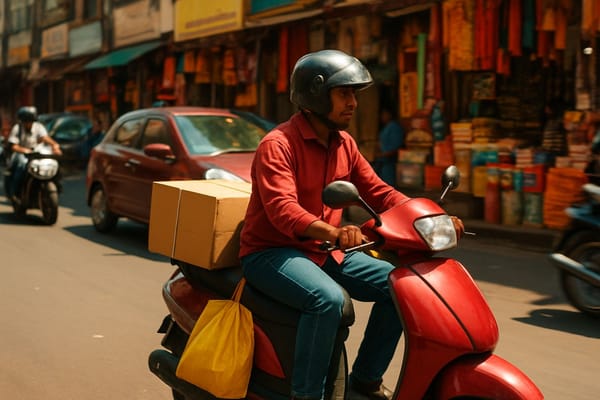
What is a split order, and why does it cost Indian retailers money?
A split order is a single customer order that ships in more than one parcel because the items sit in different places, such as a warehouse, a store and a second store. Each extra parcel adds a courier charge, a packing cost and one more chance of a delivery failure, so splits quietly cut margin on orders that look profitable.
For a chain selling online and in stores, splits are not an edge case. They are what happens by default once stock is spread across locations and the order system simply routes each line to whichever location has units. A customer who orders a kurta, a dupatta and a pair of juttis can end up with three couriers, three tracking links and three chances to refuse delivery.
The fix is not to ban splits. It is to decide, order by order, whether splitting is worth it, using rules your team can read and change. This guide covers the mechanism, the costs to measure and a step by step setup.
Where do split orders come from?
Most splits come from stock being visible but not consolidated: the same SKU is available in several locations, none of which has the whole basket. The order system then picks the nearest or first available location per line.
- Thin stock depth per location: a store holds two units of each size, so a basket of three items rarely sits fully in one place.
- Line-level routing: the system assigns each line separately instead of scoring whole-basket options first.
- Stale inventory: a unit shows as available, the picker cannot find it, and the line is reassigned to another location after the rest of the order has already been packed. Our guide to omnichannel inventory sync explains why this happens.
- Mixed fulfilment promises: same-day items from a store and standard items from a warehouse in one cart.
What does a split order actually cost?
The cost of a split is the sum of the extra forward shipping, the extra packing, the higher return risk and the support effort, and you can calculate it per order from your own data. Do not rely on an industry average, because courier rate cards, parcel weights and pincodes differ for every chain.
Pull the last 90 days of orders that shipped in two or more parcels and compare them with single-parcel orders of similar value. Measure these five numbers:
| Measure | Why it matters |
|---|---|
| Shipping cost per order | Second and third parcels pay the base slab again, with no discount for being the same customer. |
| Packing cost per order | Extra cartons, tape, labels and handling minutes at each location. |
| Delivery success rate | Customers refuse the second parcel when they have already received "the order" in the first. |
| Return rate | A partly arrived order often turns into a full return, since the missing item was the reason for buying. |
| Support contacts per order | "Where is my other item" is one of the most repetitive tickets a retail team handles. |
Weight is the sneaky part. Couriers bill on the greater of dead weight and volumetric weight, and a small parcel can be billed at a higher slab than you expect. If you have seen unexplained charges, read how to stop courier weight discrepancy charges before you work out your split cost.
Should you split, hold or cancel a line?
Split only when the ship-together option is worse for the customer or the margin. Otherwise hold the order for a short, stated window or consolidate stock first. Cancelling a line is the last resort.
A workable decision order looks like this:
- Can one location fulfil the full basket? Ship from it, even if it is slightly farther.
- Can the missing items reach that location within the delivery promise through a stock transfer? Transfer and hold.
- Is the split cost smaller than the order margin and does the customer value speed? Split and tell them up front.
- Is the order cash on delivery? Be stricter about splits, because a second COD parcel is the one most likely to be refused. See how Indian retailers fix COD reconciliation losses for the money side.
How to set up split order rules in your order management system
You set up split rules by writing down your fulfilment priorities, encoding them as basket-level routing, and measuring the result for a month. The steps below work in any order management system that lets you configure rules, including Commmerce, an Omnichannel Retail Operating System for Indian retailers.
- Export 90 days of orders and tag every order that shipped in more than one parcel.
- Calculate the extra cost per split using your own courier invoices and packing records.
- Set a maximum number of parcels per order, for example two, and route any basket that would exceed it to a consolidation or hold rule.
- Configure routing to score whole-basket options first, then fall back to line-level routing only when no single location can fill the order.
- Define a hold window, such as 24 hours, for orders where a transfer can complete the basket, and show it on the order status page.
- Add a rule for COD and high-value orders that prefers a single parcel, even at a higher freight cost.
- Send one consolidated message to the customer that lists every parcel with its own tracking link.
- Review the split rate, split cost and refusal rate every week for the first month, then monthly.
The ship from store versus warehouse comparison shows how the same order costs different amounts depending on the origin, which feeds directly into step 4.
How do you keep the customer calm when an order does split?
Tell the customer before the first parcel leaves, list what is in each parcel, and give each one its own tracking link. Most split-order complaints are about silence, not about the split itself.
A short WhatsApp or SMS at dispatch works well: "Your order has two parcels. The kurta ships today from Pune, the dupatta ships tomorrow from Nashik. Both are on the way." Keep the invoice per parcel clear as well. For tax invoicing rules on goods supplied in more than one consignment, check the guidance on cbic-gst.gov.in or ask your chartered accountant, because the treatment depends on how your locations are registered.
How do you stop splits at the source?
Reduce splits by improving stock depth and accuracy where demand actually is, not by changing the courier. If a location sells a product often, it should hold the full size run or colour range for it.
- Cluster slow SKUs, spread fast ones: fast movers deserve depth in every store, slow movers belong in one hub.
- Fix count accuracy: phantom stock creates mid-pick reassignments. Regular counts, covered in our guide to cycle counting, remove most of them.
- Check serviceability early: if a pincode is only reachable from one location, the order should route there from the start. Pincode serviceability gaps are a common reason a second parcel fails.
- Bundle by design: sell sets and combos as one SKU stored together, so they cannot split.
India's organised retail keeps expanding, as the IBEF retail industry overview tracks, and each new location adds another place a basket can be scattered across. The Retailers Association of India (rai.net.in) also publishes industry material worth reading if you are planning multi-city growth.
Frequently asked questions
Are split orders always bad for margin?
No. A split is fine when the order margin comfortably covers the extra freight and the customer values a fast partial delivery. It hurts when low-value or cash on delivery orders ship in several parcels.
Should I charge the customer extra for a split shipment?
Usually not. Customers see one order and expect one delivery charge. It is cleaner to absorb the cost on high-margin baskets and use hold or consolidation rules on low-margin ones.
How many parcels per order is too many?
Set the limit from your own data. For most chains, anything beyond two parcels on an average order costs more than the sale earns, so route those baskets to consolidation or a hold window.
If your system routes each line on its own, you are paying for splits you never chose. Start with the 90 day export, find your real cost per split and let that number set your rules. For a wider view of vendors that support this, see our list of the top 10 order management systems for Indian omnichannel brands.