How Indian Grocery Chains Can Use OMS to Cut Order Errors in 2026
Table of Contents
- Introduction
- The Order Error Problem Facing Indian Grocery Chains
- What to Look for in an OMS for Grocery Retail
- Key OMS Features That Cut Order Errors
- How Commmerce Helps Indian Grocery Chains
- Conclusion
- FAQs
TL;DR
- Indian grocery chains selling across walk-in, online, and marketplace channels lose revenue and customer trust every day to order errors caused by disconnected billing and inventory tools.
- An Order Management System (OMS) solves this by creating one real-time inventory ledger that all channels read from, so overselling and missed orders become structurally impossible.
- Commmerce OMS syncs stock across every connected channel within 30 seconds, handles NDR as a 24-hour recovery window, and can go live on existing devices in one to five days with no hardware replacement.
- Per-order pricing at Rs 2 to Rs 5 makes unified order management accessible for grocery chains of all sizes, without expensive proprietary terminals or lengthy ERP rollouts.
Introduction
Indian grocery chains using an OMS to cut order errors in 2026 are pulling ahead of competitors still managing orders through a patchwork of Tally, WhatsApp messages, and separate marketplace dashboards. The Indian grocery retail sector has never been more complex to operate. A single mid-size chain today might be taking walk-in orders at the counter, fulfilling Swiggy Instamart listings, running its own website, and managing WhatsApp orders from regular customers, all at the same time. Without a single system to hold all of that together, order errors are not a question of if but how often.
According to IBEF's India Retail Industry report, organised grocery retail in India is one of the fastest-growing segments, driven by quick commerce and rising consumer expectations for same-day delivery. That growth puts enormous pressure on back-end operations at exactly the moment when most grocery chains are still running disconnected systems.
This guide explains what causes order errors in multi-channel grocery operations, what an OMS actually does to eliminate them, and which specific features matter most for Indian grocery chains in 2026.
The Order Error Problem Facing Indian Grocery Chains
Order errors in Indian grocery chains almost always trace back to the same root cause: inventory is owned by multiple systems at once, and those systems do not agree with each other in real time.
A typical mid-size grocery chain with five to fifteen stores runs something like this. The billing counter runs on a legacy tool like Marg ERP or Vyapar. The online store is on a separate platform. Marketplace orders from Flipkart Quick or Amazon Fresh land in their respective seller portals. A WhatsApp catalogue sends orders to a shared inbox. Nobody has a single number for available stock because every system has a different number. The result is predictable: a customer orders the last two kilograms of basmati rice online, the counter staff sells it to a walk-in customer before the online order is picked, and the grocery chain either oversells or scrambles to cancel and refund.
The operational cost of this is significant. Staff spend time every morning reconciling overnight orders across portals. Marketplace SLA penalties stack up when orders are confirmed but cannot be fulfilled on time. Returns and cancellations damage seller ratings on Flipkart and Amazon. Customer trust erodes when an order that was confirmed gets cancelled hours later.
The problem compounds with scale. A single-store grocery retailer can manage manually. A chain with ten stores, an online storefront, and two marketplace accounts cannot. The error rate does not grow linearly with the number of channels. It grows faster, because each new channel is another source of conflicting stock data.
⚠️Watch OutReconciling stock across even three channels manually takes tens of minutes per day under normal conditions. During a sale event or festive rush, the same reconciliation becomes impossible in real time, and that is exactly when overselling causes the most customer-facing damage.
Tools like Vyapar and Marg ERP are designed for single-channel billing and accounting. They are not built to aggregate orders from a website, a marketplace, and a walk-in counter into one live ledger. TallyPrime handles GST and accounting well but has no order routing or multi-channel sync capability. These are good tools for the jobs they were designed for. They are not order management systems, and using them as a substitute for one is what creates the error gap.
For a deeper look at how OMS fits into the broader retail operations stack, see this Order Management System (OMS) Guide for Indian Retailers.
What to Look for in an OMS for Grocery Retail
An OMS for Indian grocery chains must do one thing above everything else: own inventory truth. Every other capability depends on having a single, real-time stock number that every channel reads from and never argues with.
Beyond that core requirement, there are five things that separate a grocery-ready OMS from a generic order management tool.
Real-time multi-channel inventory sync. Stock changes from any source, a walk-in sale, an online order, a warehouse receipt, must reach every connected channel fast enough to prevent a second sale of the same unit. Thirty seconds or less is the practical threshold for grocery, where demand spikes quickly during the morning rush or a festive promotion.
Atomic reservation. When two customers try to buy the last unit on two different channels at the same moment, the system must guarantee that only one of them succeeds. This is not a nice-to-have. It is the technical mechanism that makes overselling structurally impossible rather than just less likely.
NDR and failed delivery handling. Grocery delivery has a high failure rate on first attempt, particularly for COD orders. An OMS that does not manage NDR as a first-class flow leaves failed deliveries to auto-return without giving the merchant a recovery window.
GST e-invoicing and Indian compliance. Grocery chains in India are subject to GST on most packaged goods, and e-invoicing requirements under the GSTN e-invoicing framework apply to businesses above the applicable turnover threshold. An OMS that integrates GST e-invoicing into the order flow removes a manual reconciliation step that otherwise happens at the end of every day.
Works on existing hardware, fast to deploy. A grocery chain cannot afford a three-month ERP implementation. The OMS must install on existing Windows PCs, Android tablets, or iOS devices without requiring proprietary terminals or new hardware, and go live in days, not months.
💡Pro TipBefore evaluating any OMS, ask vendors a single pointed question: where does inventory live? If the answer is anything other than one central ledger that all channels read from, you will still be reconciling spreadsheets six months later.
Key OMS Features That Cut Order Errors in Grocery Chains
The features below are the specific OMS capabilities that eliminate the most common sources of order error in grocery retail. Each one addresses a failure mode that manual or disconnected systems cannot solve.
One Canonical Inventory Ledger Across Every Channel
The single most important feature in any OMS for grocery retail is a canonical inventory ledger: one record of available stock per SKU per location that every channel reads from and only the OMS can write to. Channels stop owning stock. They send orders in and read available quantity out. When a unit is sold at the counter, the available quantity drops immediately across the online store, the marketplace listings, and the quick commerce integration. There is no version of the stock number that any channel holds independently.
This is the structural fix for the overselling problem. It is not a sync feature or a reconciliation feature. It is an architectural decision that makes multi-channel stock conflict impossible by design.
Atomic Reservation to Stop Simultaneous Oversells
A canonical ledger alone is not enough if two channels can read the same available quantity at the same moment and both place an order before either reservation is recorded. Atomic reservation solves this by locking the inventory row at the moment of order creation. The first order to arrive gets the reservation. The second reads zero and cannot confirm. This is the technical mechanism that handles peak demand, festive sales, and flash promotions without overselling.
For grocery chains running Big Billion Days promotions on Flipkart while also taking walk-in orders at the counter, atomic reservation is the difference between a managed sale event and a customer service crisis.
30-Second Inventory Sync Across All Connected Channels
Stock updates must reach every connected channel quickly enough to prevent a sale of a unit that was just reserved elsewhere. A sync window of 30 seconds is sufficient for most grocery operations to prevent the gap between a reservation and its propagation from causing a second sale. This matters most during high-velocity periods: morning delivery windows, lunchtime online ordering peaks, and festive promotions.
It also matters for marketplace compliance. If a grocery chain's Flipkart listing shows stock that is no longer available, the resulting cancellation counts against the seller's service score.
Unified Order Queue with SLA Prioritisation
Every order from every channel lands in a single queue, automatically prioritised by which deadline is closest. A Flipkart order with a 2-hour dispatch SLA surfaces above a next-day delivery order from the online store. Staff do not need to check multiple portals or guess which order to pick first. The system tells them. This reduces missed SLA penalties and the human error that comes from switching between multiple dashboards under time pressure.
For grocery chains where order volume spikes unpredictably, a unified queue with automatic prioritisation is the operational equivalent of adding a warehouse coordinator without the headcount cost.
NDR Management as a 24-Hour Recovery Window
Failed deliveries are a significant operational cost in grocery fulfilment, particularly for COD orders where customers are not always available at the delivery address. When a courier marks a delivery as failed, the OMS moves the order into a pending NDR action state with a deadline. The merchant has 24 to 48 hours to act: reattempt delivery, update the address, offer prepaid instead of COD, or cancel and trigger a return. If the deadline passes without action, the OMS automatically initiates the return flow.
Without NDR management in the OMS, failed deliveries either auto-return without a recovery attempt or require manual monitoring of each courier portal. Both outcomes cost the grocery chain money and customer relationships. For more on how quick commerce fulfilment connects to OMS operations, see the Quick Commerce Fulfilment for Indian Grocery Chains: 2026 Guide.
GST E-Invoicing and Tally Integration in the Order Flow
Indian grocery chains above the applicable GST e-invoicing turnover threshold are required to generate e-invoices through the GSTN portal for B2B transactions. When this is handled outside the OMS as a separate end-of-day step, it creates a reconciliation task and a risk of errors when invoice data does not match order data. Integrating GST e-invoicing into the order flow means every qualifying order generates a compliant invoice automatically, without a separate manual step. Tally integration in the same flow means the accounts record updates without re-keying.
Marketplace Connectors Built for Indian Platforms
Generic OMS platforms built for global markets often treat Indian marketplaces as an afterthought. Flipkart and Amazon India have specific technical realities: Amazon India is polling-only with no webhooks and requires inventory updates via feeds. Flipkart uses a webhook-primary connector with a polling fallback. An OMS built for Indian grocery chains needs connectors that handle these realities natively, not as workarounds. This is particularly relevant for grocery chains already selling on Flipkart Quick or Amazon Fresh who need those channels integrated into the unified order queue without custom development work.
For context on how delivery operations integrate with these channels, see Quick Commerce vs Last-Mile Delivery for Indian Grocery Chains.
| Capability | Legacy Tools (Marg, Vyapar, Tally) | Commmerce OMS |
|---|---|---|
| Inventory ownership | Each system holds its own stock count | One canonical ledger, all channels read from it |
| Oversell prevention | Manual reconciliation after the fact | Atomic reservation, structurally impossible to oversell |
| Channel sync speed | Manual or end-of-day batch | Within 30 seconds of any stock change |
| Order queue | Separate portals per channel | One unified queue, auto-prioritised by SLA deadline |
| NDR handling | Manual monitoring per courier portal | First-class 24 to 48 hour recovery window, auto-return on deadline |
| GST e-invoicing | Separate end-of-day step | Integrated into the order flow |
How Commmerce Helps Indian Grocery Chains Cut Order Errors
Commmerce is an Omnichannel Retail Operating System built specifically for Indian retailers. Its OMS module is not a standalone bolt-on tool. It is one part of one unified platform where POS, online store, inventory, order management, warehouse, and delivery all share the same live data. For a grocery chain, this means there is no reconciliation gap between what the billing counter sold and what the online store has available, because both run on the same ledger.
Here is how each core OMS capability maps to the order error problems Indian grocery chains face in practice.
One System, Not a Stack of Disconnected Tools
Every other OMS in the Indian market, including Unicommerce and Vinculum, is a standalone system that a retailer wires into a separate POS and a separate website. The reconciliation problem does not go away. It just moves to the integration layer. Commmerce OMS is one module of one platform. The same ledger that runs the billing counter at the store also runs the online storefront, the Flipkart account, and the warehouse picker's view. There is nothing to reconcile between order management and everything else, because it is all one system. For grocery chains that have grown beyond what Marg ERP or Vyapar can manage across multiple channels, this is the architectural difference that actually solves the problem rather than managing it.
Runs on Existing Devices, Live in Days
Commmerce runs on Windows, Mac, Android, iOS, and web browsers. It installs on the devices a grocery chain already owns: the counter PC, the manager's tablet, the warehouse Android device. There is no proprietary hardware requirement, no expensive terminals to procure, and no data migration project to manage. A new customer can connect their channels, sync their catalogue and inventory, and go live in one to five days. This is not an enterprise ERP rollout measured in months. It is a deployment measured in working days, which matters for grocery chains that cannot pause operations for a system migration.
Built for Indian Operations: NDR, GST, COD, and Tally
Commmerce OMS handles the operational realities that are specific to Indian grocery retail. NDR is treated as a 24 to 48 hour recovery window with a hard deadline, not as an automatic return. COD-to-prepaid switching is available within the NDR flow, so a failed cash delivery can be converted to an online payment link rather than returned. GST e-invoicing is integrated into the order flow. Tally integration is included for accounting. SLA breach alerts notify the team before a marketplace penalty is triggered, not after.
For grocery chains managing demand forecasting alongside order operations, see How Indian Grocery Chains Can Cut Dead Stock with Demand Forecasting.
Per-Order Pricing That Scales with the Business
Commmerce OMS is priced per order at Rs 2 to Rs 5, with a monthly minimum commitment. There is no per-terminal charge, no per-feature nickel-and-diming, and no requirement to buy into a larger enterprise contract to access the core capabilities. A grocery chain with five stores processing 500 orders a month pays a very different amount than one processing 50,000, and the pricing reflects that. As the chain adds more channels, such as a new marketplace or a quick commerce integration, those channels join the same ledger and share the same order management capability without requiring a separate module purchase.
For grocery chains exploring how to set up quick commerce delivery operations, the Quick Commerce Setup for Indian Grocery Chains: 10-Min Delivery Hub Guide covers the delivery side of the stack.
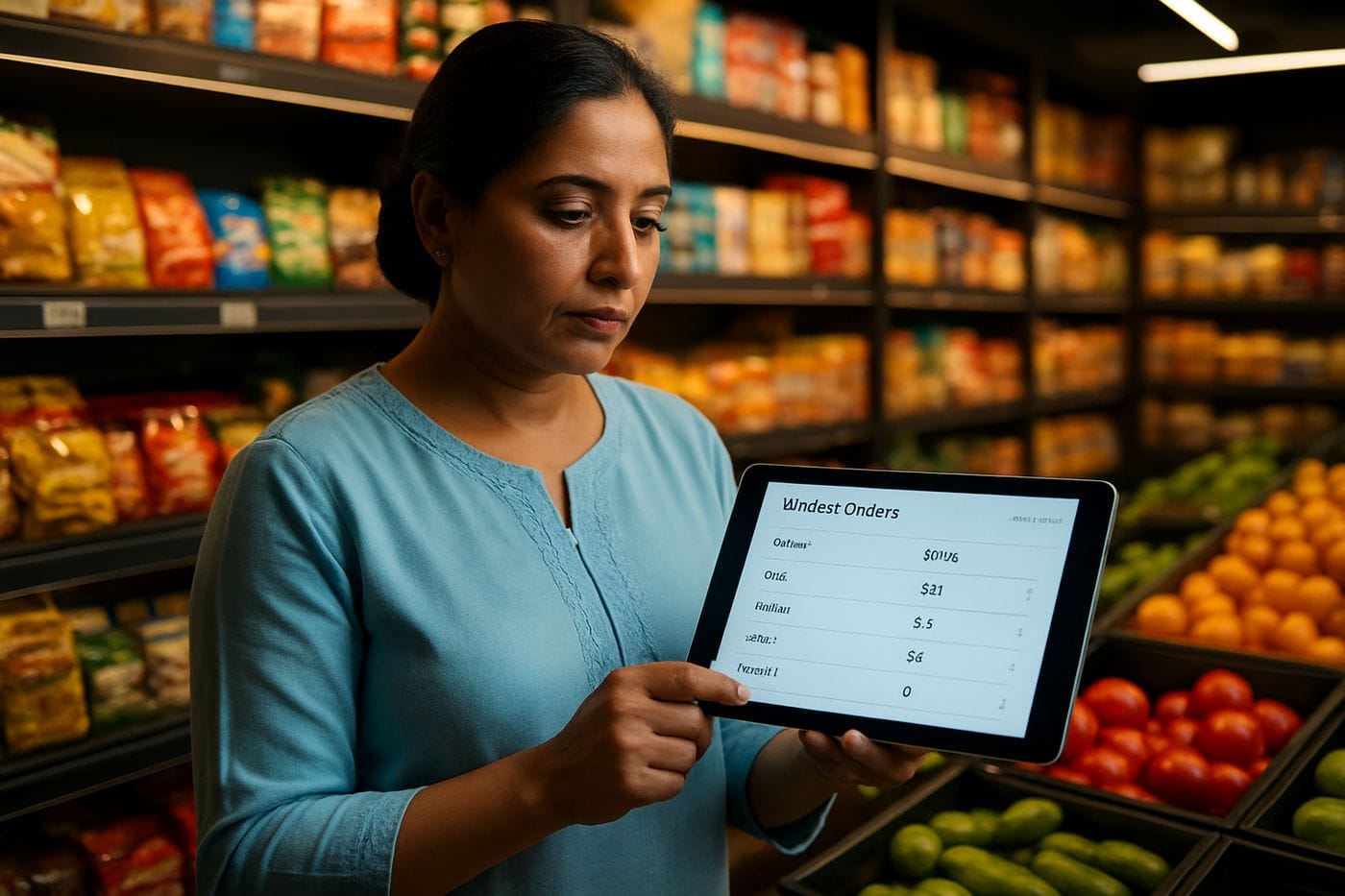
Stock updates reach every connected channel within 30 seconds of any change, including during peak sale events. Commmerce OMS sync architecture, with retries on failureRunning a grocery chain in India? See how Commmerce unifies your stores, inventory, orders and delivery in one platform so order errors stop being a daily problem.
Conclusion
Indian grocery chains using an OMS to cut order errors in 2026 are solving a problem that disconnected billing tools and manual reconciliation cannot fix at scale. The root cause of most order errors in multi-channel grocery operations is simple: inventory is owned by multiple systems simultaneously, and those systems disagree. An OMS fixes this architecturally by creating one canonical stock ledger that every channel reads from and only the OMS writes to. Atomic reservation ensures two channels cannot both sell the last unit. Real-time sync within 30 seconds closes the window between a reservation and its propagation to every channel. NDR management turns failed deliveries into recovery opportunities rather than automatic losses. And because Commmerce OMS is one module of one platform rather than a standalone tool bolted onto a separate POS and website, there is no integration layer to maintain and no reconciliation gap to close. For Indian grocery chains ready to move beyond manual order management, the capability is available, runs on existing devices, and goes live in days.
FAQs
Q: What is an OMS and why do Indian grocery chains need one in 2026?
A: An OMS, or Order Management System, is a centralised system that captures every order from every sales channel, including walk-in, online, and marketplace, into one place and manages the full lifecycle from confirmation to delivery. Indian grocery chains need one in 2026 because multi-channel selling has made manual order tracking through spreadsheets and separate billing tools too slow and too error-prone, leading to oversells, missed orders, and stockouts.
Q: How does an OMS prevent overselling across multiple grocery channels?
A: An OMS prevents overselling by maintaining a single, real-time inventory ledger that all channels read from. When a unit is reserved on one channel, it is atomically locked so no other channel can sell the same unit. Commmerce OMS uses row-level locking so two channels physically cannot both sell the last unit, and stock updates reach every connected channel within 30 seconds.
Q: Can a grocery chain go live with an OMS without replacing all its hardware?
A: Yes. Commmerce OMS installs on existing devices including Windows PCs, Android tablets, and iOS devices, with no requirement for proprietary terminals or new hardware. Most grocery retailers can connect their channels, sync their catalogue and inventory, and go live within one to five days.
Q: How does OMS help with failed deliveries and NDR in grocery fulfilment?
A: When a courier fails a delivery, the OMS places the order into a pending NDR action state with a 24 to 48 hour window for the merchant to act, whether that means reattempting delivery, updating the customer address, or switching the order from COD to prepaid. If no action is taken within the deadline, the OMS automatically moves the order into a return flow so nothing is left stranded.
Q: Is an OMS affordable for a mid-size Indian grocery chain with 5 to 20 stores?
A: Yes. Commmerce OMS uses a per-order pricing model in the range of Rs 2 to Rs 5 per order with a monthly minimum, so the cost scales with actual order volume rather than charging a flat fee regardless of usage. There is no per-feature or per-terminal charge, which makes it accessible for grocery chains with 5 to 20 stores.
Disclaimer: This article is for general informational purposes only and does not constitute legal, financial, or tax advice. GST rules, compliance requirements, and platform features may change over time. Please verify the latest guidelines with a qualified professional or refer to official sources such as the GSTN or CBIC. Market statistics mentioned are based on publicly available estimates and may not reflect current figures. Commmerce product features referenced are accurate at the time of writing and subject to change.