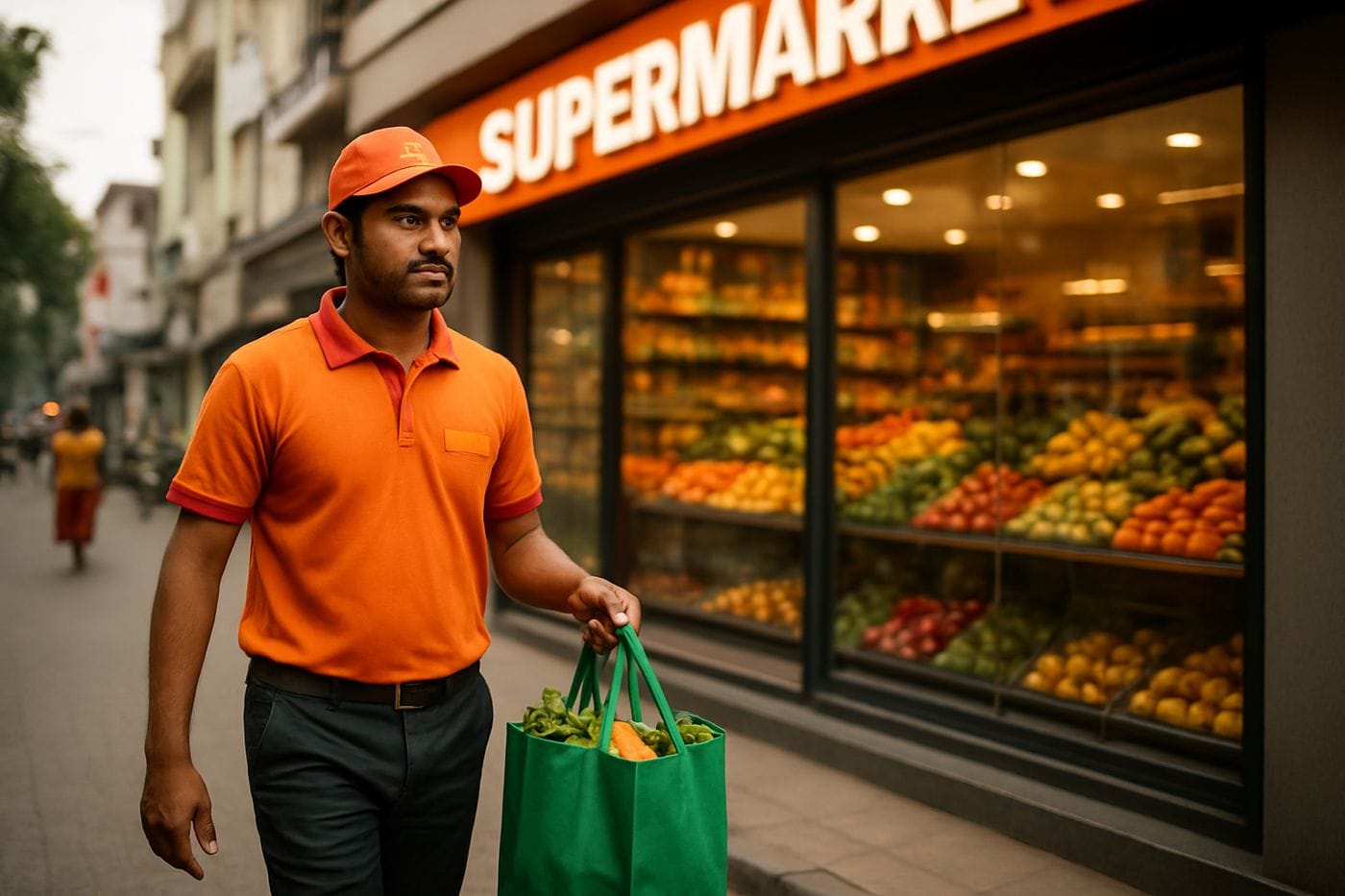
Quick Commerce vs Last-Mile Delivery: Which Fulfils Indian Grocery Chains Faster?
Table of Contents
- Introduction
- Quick Comparison: Quick Commerce vs Last-Mile Delivery
- What Is Quick Commerce and How Does It Work for Grocery Retailers?
- What Is Last-Mile Delivery and How Does It Work for Grocery Chains?
- Head-to-Head: Price, Features, and India-Specific Support
- Which Should Indian Grocery Chains Choose?
- How Commmerce Fits In: Going Beyond Both
- Conclusion
- FAQs
TL;DR
- Quick commerce wins on delivery speed (under 30 minutes) but comes with high commission costs, dark-store infrastructure requirements, and limited geographic reach outside Tier 1 cities.
- Last-mile delivery using a retailer's own fleet combined with multi-carrier shipping gives Indian grocery chains better cost control, wider zone coverage, and full visibility into COD and driver performance.
- Most multi-store Indian grocery chains benefit from a hybrid approach: quick commerce for dense urban micro-zones and structured last-mile delivery for all other orders.
- Commmerce Delivery Hub lets grocery retailers manage internal fleet dispatch and 12-plus carrier shipping from one dashboard, without needing separate tools for each channel.
Quick Commerce vs Last-Mile Delivery: Why Indian Grocery Chains Must Get This Right
The debate between quick commerce vs last-mile delivery for Indian grocery chains is no longer an abstract strategy question. It is a daily operational decision that affects how fast your customer gets their order, how much it costs you to fulfil it, and whether your delivery experience builds loyalty or erodes it. As Indian grocery retail grows in complexity, with shoppers ordering across WhatsApp, apps, and walk-ins simultaneously, the fulfilment model a chain chooses can determine whether it scales profitably or bleeds margin on every order.
Direct answer: Quick commerce fulfils faster (under 30 minutes) but suits dense urban markets with small baskets. Last-mile delivery is more cost-efficient and scalable across geographies, making it better suited for most Indian grocery chains operating across multiple stores and pin codes.
This post compares both models across speed, cost, infrastructure, India-specific requirements, and long-term fit for grocery chains with 2 to 50 stores. Whether you run a neighbourhood supermarket chain in Tier 2 cities or a multi-format grocery operation in metros, this breakdown will help you make the right call. You can also read our Last-Mile Delivery and Fulfilment Guide for Indian Retailers for a deeper dive into fulfilment fundamentals.
Quick Comparison: Quick Commerce vs Last-Mile Delivery
Before going into detail, here is a side-by-side snapshot of how both fulfilment models compare on the criteria that matter most to Indian grocery retailers.
| Criteria | Quick Commerce | Last-Mile Delivery |
|---|---|---|
| Delivery speed | 10 to 30 minutes | Same day to next day |
| Infrastructure needed | Dark stores or micro-fulfilment centres | Existing store as fulfilment point |
| Cost per order | High (platform commission plus dark store ops) | Lower with own fleet; variable with carriers |
| Geographic reach | Dense urban zones only | City-wide and outstation |
| COD support | Limited or platform-managed | Full COD with driver reconciliation |
| Basket size fit | Small, urgent, top-up grocery | Small to large baskets |
| Brand visibility | Low (platform-branded experience) | High (branded tracking, own riders) |
| Multi-store scalability | Requires dark store per zone | Each store is its own fulfilment node |
💡Pro TipDo not choose between quick commerce and last-mile delivery based on speed alone. The right model depends on your average basket size, delivery radius, and whether you want to own the customer relationship or rent it from a platform.
What Is Quick Commerce and How Does It Work for Grocery Retailers?
Quick commerce, often called q-commerce, is a fulfilment model built around delivering grocery and daily essentials to customers within 10 to 30 minutes of order placement. It relies on dark stores or micro-fulfilment centres positioned close to residential demand clusters, with dedicated rider networks available on standby.
How the Quick Commerce Model Works
In a quick commerce setup, inventory is not held in a retail store open to walk-in customers. It sits in a small, strategically located dark store, typically covering 500 to 2,000 square feet, stocked with fast-moving SKUs. When an order comes in through an app, a picker pulls items from shelves, and a rider on a two-wheeler delivers within the promised window.
Platforms like Blinkit, Zepto, and Swiggy Instamart operate this model at scale in Indian metros. For a grocery chain to participate, they either list products on one of these platforms (and pay commission) or build their own quick commerce capability with dark store infrastructure and a dedicated rider pool.
Where Quick Commerce Wins for Indian Grocery
- Speed: Nothing beats 10 to 30 minute delivery for urgent, top-up grocery needs like vegetables, eggs, or baby products.
- Conversion on impulse purchases: Customers browsing an app and craving a specific product are more likely to complete the order when delivery is nearly instant.
- Competitive differentiation in metros: In cities like Bengaluru, Mumbai, and Delhi, quick commerce has shifted consumer expectations. Not offering it can mean losing customers to platforms that do.
Where Quick Commerce Struggles
- High cost of operations: Dark stores, standby riders, and platform commissions add up. According to industry estimates, quick commerce platforms charge between 18 and 30 percent commission on gross merchandise value, which can destroy margins on low-ticket grocery orders.
- Limited geographic reach: Quick commerce only works where rider density and dark store proximity align. Tier 2 and Tier 3 cities, and even outer zones of metros, are largely underserved.
- SKU limitations: Dark stores carry a curated range of fast-moving products, not a full grocery catalogue. Specialty items, bulk orders, and low-frequency SKUs are often unavailable.
- No owned customer relationship: If you list on Blinkit or Zepto, the platform owns the customer data. Your brand is secondary.
For grocery chains looking at quick commerce enablement tools specifically, our post on Top 10 Quick Commerce Enablement Tools for Indian Grocery Chains covers the technology landscape in detail.
What Is Last-Mile Delivery and How Does It Work for Grocery Chains?
Last-mile delivery for grocery retailers covers the final leg of fulfilment, from the store or warehouse to the customer's doorstep. Unlike quick commerce, it does not require a separate dark store. Each physical store acts as a fulfilment point, dispatching orders via the retailer's own delivery riders or through third-party carriers.
How Last-Mile Grocery Delivery Works in Practice
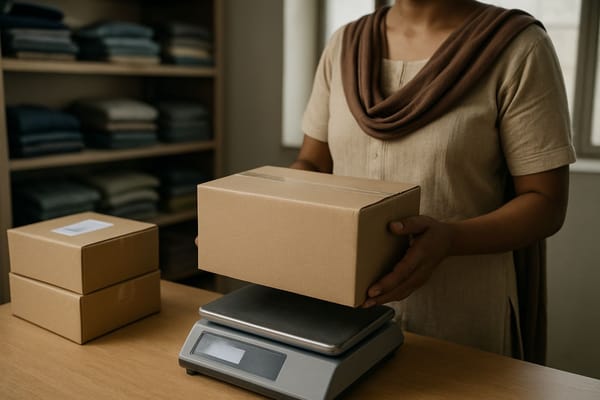
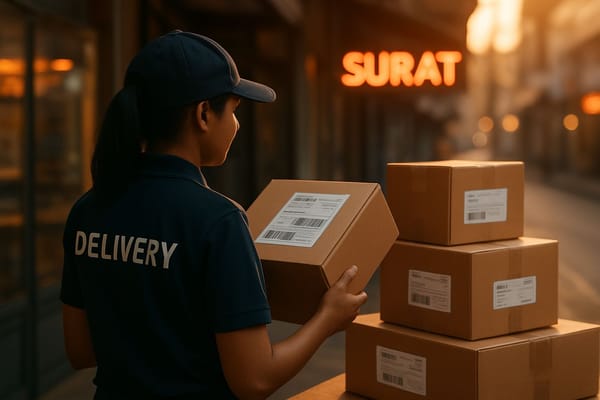
A customer places an order online, on WhatsApp, or through the store's app. The order is routed to the nearest store with stock. A picker pulls the items, and the order is either handed to an in-house delivery rider (for local delivery) or booked with a carrier like Delhivery, Porter, or Shadowfax for wider coverage. The customer receives a tracking link and can follow the delivery in real time.
This model is the backbone of how most Indian grocery chains of 5 to 50 stores fulfil home delivery today. It is also how Indian grocery delivery for last-mile operations scales without requiring parallel dark store investment.
Where Last-Mile Delivery Wins for Indian Grocery
- Lower cost structure: Using your own riders for local delivery eliminates platform commission. At 50 to 5,000 orders per day, own-fleet economics are significantly better than quick commerce platform fees.
- Full COD support: Cash-on-delivery remains a dominant payment preference in Indian retail, particularly in Tier 2 and Tier 3 markets. A robust last-mile system tracks every rupee from customer to driver to store deposit.
- Zone flexibility: Pincode-based zone management lets retailers define delivery pricing and SLAs by area, covering both high-density urban zones and lower-frequency outstation deliveries.
- Brand ownership: A branded tracking page with your store's name and logo, sent to the customer via link, reinforces your identity with every order.
- Wider SKU and basket size coverage: There is no SKU limit. Large monthly grocery orders, bulk purchases, and specialty items all fit into a standard last-mile workflow.
Where Last-Mile Delivery Faces Challenges
- Speed ceiling: Even a well-run last-mile operation rarely delivers in under 60 minutes for grocery. If a customer expects a 20-minute window, last-mile alone cannot meet that expectation without hyperlocal carrier integrations.
- Operational complexity at scale: Managing drivers, carrier bookings, COD reconciliation, and proof of delivery across multiple stores requires a centralised platform, not spreadsheets or separate apps per store.
- Carrier juggling: Retailers often work with Delhivery for one zone, Porter for another, and Shadowfax for hyperlocal. Without a unified dashboard, tracking across these becomes a daily operational headache.
⚠️Watch OutRetailers who rely on manual WhatsApp coordination between store managers and delivery riders have no visibility into undelivered orders, outstanding COD, or driver performance, and this breaks down completely once order volumes cross 100 per day per store.
For a practical guide on building a multi-carrier last-mile setup, read our Guide to Sales Channel and Delivery Aggregators for Indian Retailers.
Head-to-Head: Price, Features, and India-Specific Support
When comparing quick commerce vs last-mile delivery for Indian grocery chains specifically, three dimensions matter most: what you pay per order, what operational features you get, and how well each model handles India-specific requirements like COD, GST, and pincode-based logistics.
Price Comparison
Quick commerce platforms typically charge commission on each order, and this fee can range significantly depending on the platform, category, and negotiated terms. For a grocery chain doing ₹50 lakh per month in delivery orders, a 20 percent commission means ₹10 lakh per month going to the platform. Own-fleet last-mile delivery, even after driver salaries and fuel costs, is materially cheaper at this volume. At lower volumes, the economics are closer, and platform fees may be worth paying for the rider network access.
Third-party carrier costs for last-mile delivery vary by distance and carrier. Integrating multiple carriers and comparing rates automatically, as a unified delivery management platform enables, helps reduce per-shipment cost without sacrificing SLA.
Features for Indian Grocery Operations
Quick commerce platforms handle picking, packing, dispatch, and tracking within their own ecosystem. This is convenient but leaves the retailer with little control or visibility into operations beyond what the platform reports.
Last-mile delivery with a proper platform gives retailers proof of delivery (photo and digital signature), real-time driver GPS tracking, SLA breach alerts, bulk order management, and COD reconciliation at the driver level. These are features that matter when you have 20 drivers across 10 stores and need to know exactly where your cash is at any point in the day.
India-Specific Requirements
COD management is where last-mile delivery has a clear structural advantage. Quick commerce platforms settle COD on their own schedules and hold cash in transit according to their reconciliation cycles. With own-fleet last-mile delivery, every cash collection is tracked in real time, driver deposits are verified, and outstanding COD per rider is visible on a single dashboard.
Pincode-based zone management is also critical for Indian grocery operations. Delivery pricing, SLAs, and carrier selection often vary by the 6-digit pincode of the delivery address. A last-mile platform built for India handles this natively. Quick commerce platforms handle it internally but do not expose this logic to the retailer.
According to the India Brand Equity Foundation, India's retail sector continues to grow rapidly, with grocery and FMCG among the fastest-growing segments for organised retail. Getting fulfilment right is no longer a back-office concern; it is a competitive differentiator.
For a broader view of how top grocery chains are evaluating delivery software, our list of Top 10 Delivery Management Software for Indian Multi-Store Chains is a useful reference.
Which Should Indian Grocery Chains Choose?
The right choice between quick commerce and last-mile delivery depends on your store footprint, customer base, average basket size, and the cities you operate in. There is no universal answer, but there is a useful framework.
Choose Quick Commerce If
- You operate in dense metro catchments (Bengaluru, Mumbai, Delhi, Hyderabad, Pune) where 10 to 30 minute delivery is already a consumer expectation.
- Your average basket size is small (under ₹500), and speed is the primary conversion trigger for your customers.
- You have the margin headroom to absorb platform commissions without destroying profitability on individual orders.
- You want to test a new geography or customer segment without investing in your own rider fleet upfront.
Choose Last-Mile Delivery If
- You run 5 or more stores and want each store to fulfil local orders without depending on a third-party platform's dark store network.
- Your customers include a significant proportion of COD payers, bulk buyers, or subscribers in Tier 2 and Tier 3 cities.
- You want to own the customer relationship and keep your brand front and centre throughout the delivery experience.
- You need to manage both own-rider delivery for local zones and carrier-based delivery for outstation orders from the same dashboard.
The Hybrid Model: The Right Answer for Most Grocery Chains
For most Indian grocery chains with 5 to 50 stores, the practical answer is a hybrid: use quick commerce platforms for high-density urban micro-zones where speed is the differentiator, and run structured last-mile delivery with your own fleet and multi-carrier shipping for all other orders. This approach maximises speed where it matters and controls cost everywhere else.
The key enabler for this hybrid model is a unified delivery management platform that handles your own fleet and external carriers together, so your store managers are not toggling between five different apps to fulfil a hundred orders a day. Read more on preventing margin loss through the right fulfilment strategy in our post on Preventing Revenue Loss in 2026: Omnichannel Strategies for Grocery Chains.
It is also worth noting that legacy tools like Tally, Marg ERP, and Vyapar, which many Indian grocery chains still use for billing and inventory, have no native delivery management capability. They cannot route orders to drivers, track COD, or integrate with carriers. Moving to a platform built for omnichannel retail operations removes these gaps entirely.
How Commmerce Fits In: Going Beyond Both
Commmerce is an Omnichannel Retail Operating System built specifically for Indian retailers with 2 to 50 stores. It unifies POS billing, inventory management, order management, warehouse operations, and delivery fulfilment into a single platform so grocery chains can run every channel from one dashboard.
Commmerce Delivery Hub: Last-Mile Built for Indian Grocery
Commmerce Delivery Hub is the delivery management layer of the platform. It handles both internal fleet dispatch and multi-carrier shipping from one unified screen. Here is what that means in practice for a grocery chain:
- Internal fleet management: Assign orders to your own delivery riders with real-time GPS tracking. Riders use an Android or iOS app to accept orders, collect COD, capture proof of delivery with photo and signature, and mark delivery complete.
- 12-plus carrier integrations: Delhivery, BlueDart, DTDC, Ecom Express, FedEx, India Post, Shiprocket, Porter, Shadowfax, FShip, DHL, and UPS are all connected. The system compares rates and SLAs across carriers and books the best option automatically.
- Porter for hyperlocal delivery: Porter integration enables same-city delivery with real-time driver tracking, which is the closest equivalent to quick commerce speed within the last-mile delivery framework.
- COD reconciliation: Every cash collection is tracked per driver. Outstanding COD balances, deposit verification, and daily settlement are all visible from the dashboard.
- Pincode-based zone management: Define delivery zones by 6-digit Indian pincode ranges with custom pricing and SLA per zone, which is exactly how Indian grocery delivery is structured operationally.
- Branded customer tracking page: Every order generates a tracking link with your store branding, keeping your identity visible to the customer through the entire delivery journey.
- Multi-store support: Each store operates as an independent fulfilment node with its own fleet, carrier configuration, and delivery zones, all managed from one account.
The Bigger Picture: Omnichannel Fulfilment
Delivery Hub does not operate in isolation. It connects to Commmerce POS for in-store order dispatch and to the Commmerce Online Store for e-commerce order fulfilment. This means a grocery chain can take an order at the billing counter, on its website, or through a WhatsApp inquiry, and route it to the right store and driver from a single operating system.
This is the gap that quick commerce platforms and standalone delivery apps both miss: they solve one piece of the fulfilment puzzle without connecting it to the rest of your retail operations. Commmerce connects inventory, order management, and delivery in one platform so you are not reconciling data across three different tools at the end of every day.
For grocery chains looking to build an online sales presence alongside their delivery operations, our How Indian Retailers Can Sell Online - Complete eCommerce Guide covers the full picture.
Running a grocery chain in India? See how Commmerce unifies your stores, inventory, orders, and delivery in one platform built for Indian retail.
Conclusion
The question of quick commerce vs last-mile delivery for Indian grocery chains does not have a single right answer, but it does have a clear framework. Quick commerce delivers speed and works well for urban, small-basket, high-frequency orders where consumers have already shifted their expectations to sub-30-minute fulfilment. Last-mile delivery with your own fleet and multi-carrier integrations gives you cost control, COD management, wider geographic reach, and full brand ownership across a broader range of order types. For most Indian grocery chains operating across multiple stores and geographies, a hybrid approach is the most practical and profitable path: quick commerce where speed is the differentiator, and structured last-mile delivery everywhere else. The retailers who will win are those who build the operational infrastructure to run both without doubling their complexity.
FAQs
Q: What is the difference between quick commerce and last-mile delivery for grocery retailers?
A: Quick commerce delivers groceries within 10 to 30 minutes using dark stores and dense urban rider networks, while last-mile delivery covers a broader range of delivery windows, typically same-day to next-day, using a retailer's own fleet or third-party carriers dispatched from existing store locations.
Q: Which is cheaper for Indian grocery chains: quick commerce or last-mile delivery?
A: Last-mile delivery using a retailer's own fleet is generally cheaper per order at scale, since quick commerce platforms charge commission fees and require investment in dark store infrastructure; however, the right choice depends on order density, average basket size, and the delivery radius the retailer needs to cover.
Q: Can Indian grocery chains run both quick commerce and last-mile delivery at the same time?
A: Yes, many multi-store Indian grocery chains run a hybrid model where quick commerce handles high-frequency, small-basket urban orders and last-mile delivery covers larger orders, outstation shipments, and areas not served by quick commerce networks.
Q: Does Commmerce support quick commerce fulfilment for Indian grocery retailers?
A: Commmerce's Delivery Hub supports last-mile delivery with internal fleet management and integrations with hyperlocal carriers like Porter and Shadowfax, which can enable fast local delivery; for quick commerce specifically, retailers should evaluate whether a dedicated dark-store model or a carrier integration through Delivery Hub best fits their fulfilment strategy.
Q: What should an Indian grocery chain with 5 to 20 stores prioritise: speed or coverage in delivery?
A: A grocery chain with 5 to 20 stores typically benefits from prioritising coverage and consistency first, using last-mile delivery with a unified platform to serve all zones reliably, and then layering quick commerce for high-density urban catchments where speed drives basket size and repeat purchases.
Disclaimer: This article is for general informational purposes only and does not constitute legal, financial, or tax advice. GST rules, compliance requirements, and platform features may change over time. Please verify the latest guidelines with a qualified professional or refer to official sources such as the GSTN or CBIC. Market statistics mentioned are based on publicly available estimates and may not reflect current figures. Commmerce product features referenced are accurate at the time of writing and subject to change.