Titan's 40% Growth Secret: Omnichannel Lessons for Indian Jewellery Chains
Table of Contents
- Introduction
- What Titan Did Right with Omnichannel Retail
- The Problem Indian Jewellery Chains Face Today
- What to Look for in an Omnichannel Platform for Jewellery Retail
- Key Capabilities That Drive Omnichannel Growth
- How Commmerce Helps Indian Jewellery Chains Scale
- Conclusion
- FAQs
TL;DR
- Titan's 40% growth in jewellery retail was powered by a unified omnichannel strategy that connected physical stores, digital channels, and customer data into a single operating model.
- Indian jewellery chains with 2 to 50 stores face the same solvable problems: inventory mismatches, siloed orders, and no real-time visibility across branches.
- Commmerce is an Omnichannel Retail Operating System built for Indian retailers that unifies POS, inventory, online store, OMS, and delivery in one platform without expensive hardware or long migrations.
- Retailers still running on Tally, Marg ERP, or disconnected tools can switch to a modern omnichannel platform and go live fast on hardware they already own.
Introduction
Titan's 40% growth secret in jewellery retail is no mystery to those who have studied its playbook closely: the company invested relentlessly in omnichannel retail, connecting its Tanishq stores, its digital storefronts, and its customer engagement systems into one unified experience. According to IBEF's Gems and Jewellery Industry report, India's gems and jewellery sector contributes around 7% to total exports and is one of the fastest-growing retail categories, yet the majority of Indian jewellery chains are still running on disconnected billing tools, manual stock registers, and separate systems for online and offline orders. The gap between what Titan built and what most regional jewellery chains operate on today is enormous, and that gap is precisely where growth is being lost.
This post breaks down the omnichannel lessons Indian jewellery chains can extract from Titan's approach, and shows how a modern retail operating system can help multi-store jewellery retailers replicate that playbook at a fraction of the cost.
What Titan Did Right with Omnichannel Retail
Titan's omnichannel retail strategy worked because it treated every customer touchpoint as part of one connected system, not as separate business units.
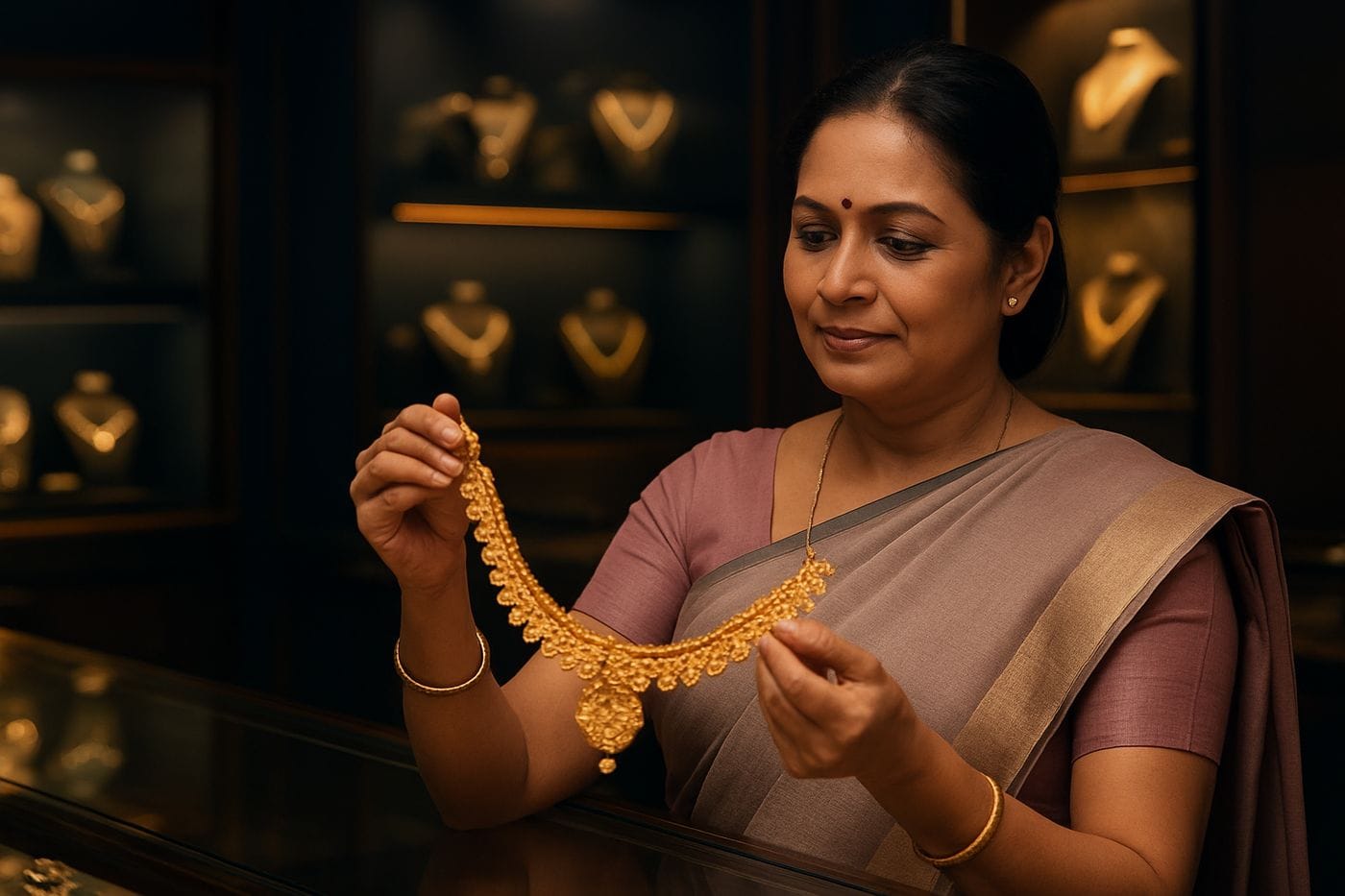
Tanishq, Titan's jewellery brand, did not simply launch a website alongside its stores. It built a model where a customer could browse designs online, visit a store to try them on, pay partially as a deposit digitally, and complete the purchase in person without any friction or data loss between those steps. That level of integration requires three things that most Indian jewellery chains currently lack: unified inventory across locations, a real-time order management layer, and a connected customer profile that follows the shopper across channels.
Titan also invested in customer loyalty and CRM at scale. Members of its loyalty programme received personalised offers based on purchase history, and those offers were redeemable both online and in-store without any manual intervention at the counter. This kind of seamless customer engagement is what drives repeat purchases in a high-consideration, high-value category like jewellery.
For more context on how omnichannel strategy works across retail categories, read The Complete Guide to Omnichannel Retail for Indian Businesses.
India's organised jewellery retail market is growing at double digits, yet over 70% of regional chains still manage inventory manually across branches. According to industry estimates cited in IBEF's Gems and Jewellery sector overview.
The Problem Indian Jewellery Chains Face Today
Most Indian jewellery chains with 2 to 20 stores are running operations that look nothing like Titan's, not because they lack ambition, but because the tools available to them were not designed for omnichannel retail.
Here is what a typical multi-store jewellery retailer's technology stack looks like in 2026:
- Tally or Marg ERP for accounting and billing at each store, updated manually at the end of the day
- A separate Shopify or WooCommerce store for online orders, with inventory managed independently from the physical store
- WhatsApp groups for communicating stock availability between branch managers
- Excel sheets for tracking gold and diamond inventory across locations
- No unified customer profile, so a loyal customer at the Bandra branch is completely unknown to the Andheri branch
The result is predictable. When a customer orders a ring online that is actually sitting in a different branch than the one fulfilling the order, the team discovers the mismatch only after the order is confirmed. Returns and exchanges become manual nightmares because there is no system that knows where the item was purchased or what the customer's history looks like. GST reconciliation at month-end takes days because billing data sits in three different systems.
These are not small inefficiencies. Each one is a direct revenue leak. Stock mismatches mean cancelled orders and lost trust. Manual GST filing means compliance risk. No customer profile means zero personalised marketing and lower repeat purchase rates in a category where loyalty is everything.
Retailers using legacy tools like Vyapar, Marg ERP, or TallyPrime get accounting functionality, but none of those tools were built to unify physical store operations with an online channel, OMS, or delivery management. They are billing tools in a world that now demands a full operating system.
⚠️Watch OutRunning your jewellery chain on separate billing, inventory, and ecommerce tools does not just slow you down - it creates silent revenue leakage through stock mismatches, fulfillment errors, and missed loyalty opportunities that compound every month.
What to Look for in an Omnichannel Platform for Jewellery Retail
Indian jewellery chains should evaluate any omnichannel platform on five criteria before committing: real-time inventory across branches, unified order management, offline billing reliability, built-in GST compliance, and customer loyalty that works across all channels.
The comparison below shows how a modern omnichannel retail operating system stacks up against the typical disconnected tool stack that most jewellery chains are running today.
| Capability | Legacy Tools (Tally + Shopify + Excel) | Modern Omnichannel OS (Commmerce) |
|---|---|---|
| Real-time inventory across branches | Manual sync, often end-of-day | Live across all stores and warehouses |
| Unified order management (OMS) | Not available, orders managed per channel | Single OMS for walk-in, online, and WhatsApp orders |
| Offline POS billing | Dependent on internet connectivity | Offline-first, syncs automatically when online |
| GST billing and e-invoice | Separate filing, manual reconciliation | Built-in GST billing with GSTN e-invoice integration |
| Customer loyalty across stores | Store-level only, not portable | Centralised CRM and loyalty across all branches |
Also relevant: see how Indian jewellery chains can sync online and walk-in orders in a practical step-by-step breakdown.
Key Capabilities That Drive Omnichannel Growth
The following capabilities are what separate fast-growing multi-store jewellery chains from those stuck in operational firefighting. These are the building blocks of the Titan playbook, translated into features any growing jewellery chain can adopt.
1. Centralised Real-Time Inventory Across All Branches
Jewellery inventory is high-value, often unique, and subject to weight-based pricing changes. A ring available at your Connaught Place store should be visible to the customer browsing your website or visiting your Lajpat Nagar branch. Real-time inventory visibility across all locations eliminates the single biggest source of customer disappointment in jewellery retail: being told an item is available and then finding out it is not.
The right omnichannel platform for jewellery multi-store management should support barcode and RFID-based inventory tracking so that each piece can be identified, located, and moved across branches with full audit trails. This also addresses shrinkage, a critical concern in a category where a single misplaced item can mean a significant loss.
2. Unified Order Management Across Walk-In, WhatsApp, and Online
Jewellery customers do not follow a single channel. Many discover designs on Instagram, place an inquiry on WhatsApp, visit the store to finalise, and expect to pick up or get delivery later. An Order Management System that stitches these touchpoints together into one order record is not a luxury for jewellery chains - it is a baseline requirement for growth.
Multi-channel order routing and fulfilment logic means that when an online order comes in, the platform can automatically route it to the branch with the item in stock and the fastest delivery window, rather than the retailer doing this manually over WhatsApp.
3. Offline-First POS Billing That Never Goes Down
A jewellery store cannot afford to stop billing because the internet dropped for 20 minutes. High-value transactions require a POS system that works in offline mode and syncs automatically when connectivity is restored. This is a non-negotiable for any jewellery retailer evaluating omnichannel platforms for Indian retail stores.
4. Built-In GST Compliance and E-Invoice Generation
Jewellery retail involves specific GST rules including the 3% GST on gold jewellery, 5% on making charges, and mandatory HSN code compliance. As per GSTN guidelines, e-invoicing is now mandatory for businesses above specified turnover thresholds. A modern omnichannel platform should generate GST-compliant invoices and e-invoices automatically at the point of sale, removing the month-end reconciliation burden entirely.
5. Customer Loyalty and CRM That Works Across Every Store
Titan's loyalty programme works because a customer's points, purchase history, and preferences are the same whether they walk into a Tanishq store in Chennai or Kolkata. Regional jewellery chains can replicate this by using a platform with a centralised CRM that stores customer profiles, purchase history, and loyalty points across all branches. This enables personalised outreach, anniversary reminders, and targeted promotions without any manual effort from store staff.
Omnichannel vs. Multichannel: Understanding the Difference
Many jewellery retailers think they are running an omnichannel operation because they have both a store and a website. That is multichannel, not omnichannel. The difference is integration. For a deeper comparison, read Omnichannel vs Multichannel: Which Grows Indian Fashion Chains, which explains how the same principle applies across retail categories including jewellery.
💡Pro TipBefore evaluating any omnichannel platform, map every touchpoint your jewellery customer uses today - Instagram inquiry, WhatsApp message, store visit, online checkout - and confirm the platform handles all of them from one dashboard.
How Commmerce Helps Indian Jewellery Chains Scale
Commmerce is an Omnichannel Retail Operating System built specifically for Indian retailers with 2 to 50 stores, and it is the most direct answer to every operational gap described above.
Unlike legacy tools such as Vyapar, Marg ERP, or TallyPrime, which were built for accounting and billing in a single-store context, Commmerce was designed from the ground up to run a multi-store retail business across physical and digital channels simultaneously.
Here is what jewellery chains specifically get with Commmerce:
- Real-time centralised inventory across all branches and warehouses, with barcode and RFID support so every piece of jewellery is tracked and located at all times.
- Unified OMS that consolidates walk-in orders, online store orders, and WhatsApp-based orders into a single queue with multi-channel order routing and fulfilment logic.
- Offline-first POS that continues billing during internet outages and syncs automatically when the connection is restored, so peak-hour billing never stops.
- Built-in GST billing and GSTN e-invoice integration that generates compliant invoices at the point of sale, with Tally Prime integration for retailers who want to retain their existing accounting workflow.
- Customer loyalty and CRM that maintains a unified customer profile across all store locations, enabling personalised campaigns and loyalty redemption at any branch.
- WhatsApp-based invoicing for sharing invoices and order updates directly with customers on the channel they already use.
- Native UPI payment integrations with Razorpay, PhonePe, and Paytm built in, so no third-party payment middleware is required.
- Logistics integrations with Delhivery, Shiprocket, and Ecom Express for last-mile delivery management from the same dashboard.
One of the most important practical advantages for jewellery chains evaluating platforms is that Commmerce runs on Windows, Mac, Android, iOS, and web, on affordable generic hardware. There is no expensive proprietary terminal to purchase, no data migration that takes months, and no hardware replacement required. A retailer can install Commmerce on devices already in the store and go live fast.
For retailers managing inventory across categories or considering how omnichannel inventory management applies beyond jewellery, the principles explored in How Indian Footwear Chains Can Cut Stockouts with Omnichannel Inventory translate directly to high-SKU jewellery environments as well.
Running a jewellery retail business in India? See how Commmerce unifies your stores, inventory, orders, and delivery in one platform built for Indian retailers.
Conclusion
Titan's 40% growth in jewellery retail did not happen because of a single product launch or a marketing campaign. It happened because the business invested in unified omnichannel infrastructure that made every customer interaction faster, smarter, and more personal than what a disconnected tool stack could ever deliver. The same lessons for jewellery chains in India are available to any multi-store retailer today: centralise your inventory, unify your orders, make loyalty portable, and ensure your billing never goes down. The technology to do all of this is no longer reserved for enterprise-scale companies. Modern omnichannel platforms built for Indian retailers with 2 to 50 stores bring these exact capabilities to regional jewellery chains at a cost and implementation timeline that makes the upgrade commercially obvious. The retailers who act on this in 2026 will be the ones writing the next growth story.
FAQs
Q: What is an omnichannel retail strategy for jewellery chains?
A: An omnichannel retail strategy for jewellery chains means unifying physical store billing, online orders, inventory, and customer data into a single platform so that customers get a consistent experience whether they shop in-store, on a website, or via WhatsApp.
Q: How did Titan achieve 40% growth through omnichannel retail?
A: Titan grew by investing in unified inventory visibility, digital customer engagement, and a seamless experience across its physical Tanishq stores and online channels, allowing it to serve customers at every touchpoint without friction or stock mismatches.
Q: Can mid-size Indian jewellery chains afford an omnichannel platform?
A: Yes. Modern omnichannel platforms like Commmerce are specifically designed for Indian retailers with 2 to 50 stores and offer flat pricing with no per-terminal fees, making them affordable compared to legacy ERPs or stitched-together tools.
Q: What are the biggest inventory challenges for jewellery retailers in India?
A: The biggest inventory challenges for Indian jewellery retailers include stock mismatches between physical stores and online listings, no real-time visibility across branches, manual reconciliation errors, and inability to fulfil online orders from the nearest store with available stock.
Q: How does Commmerce help jewellery retailers manage multi-store operations?
A: Commmerce is an Omnichannel Retail Operating System that gives jewellery retailers a unified dashboard to manage POS billing, real-time inventory across all branches, online orders, customer loyalty, and delivery fulfilment from a single connected platform without expensive hardware or long migration timelines.
Disclaimer: This article is for general informational purposes only and does not constitute legal, financial, or tax advice. GST rules, compliance requirements, and platform features may change over time. Please verify the latest guidelines with a qualified professional or refer to official sources such as the GSTN or CBIC. Market statistics mentioned are based on publicly available estimates and may not reflect current figures. Commmerce product features referenced are accurate at the time of writing and subject to change.