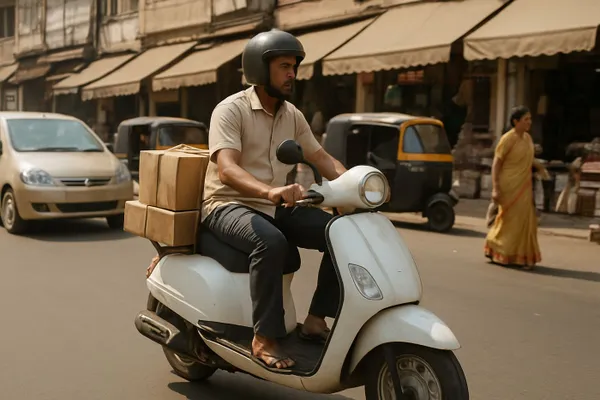
Cash on delivery collected by your own riders is not revenue until it reaches your store and is matched, order by order, to what the rider handed over. Most retail chains settle it with an end-of-day handful of notes and a number the rider remembers, which is where the money quietly leaks.
Why does rider COD cash go missing in multi-store chains?
Because the cash sits in a rider's pocket between the doorstep and the store, and nothing in that gap is recorded. A shortfall of a few hundred rupees a day per rider looks small, but across several stores and dozens of riders it becomes a monthly loss nobody can trace to a cause.
The problem is rarely theft. It is usually a mix of ordinary things: change given back from a large note and not noted, one order marked delivered with the wrong amount, a rider paying for fuel out of the cash and meaning to square it later, or two riders' collections mixed in one envelope. Without a per-order record, every one of these looks the same at night: the total is short and everyone has an explanation.
This is a different problem from courier remittance. When a courier collects COD, the partner remits it on a cycle and you reconcile against their statement, which we cover in how Indian retailers fix COD reconciliation losses. With your own fleet there is no statement. The rider is the statement, so your process has to produce one.
What does a clean rider cash settlement look like?
A clean settlement matches three numbers for every rider every day: what the orders say should be collected, what the rider says was collected, and what the store counted in hand. Any gap between them is visible the same evening, with the order that caused it.
The three numbers answer three different questions:
- Expected cash is the sum of COD amounts on the orders the rider marked delivered. It comes from the order, never from the rider.
- Declared cash is the amount the rider entered against each order at the door. A difference from expected means a partial payment, a price change or a wrong entry.
- Deposited cash is what the store counts when the rider hands over. A difference from declared means cash went missing after the door.
Keeping these separate is the whole trick. When they collapse into one end-of-day total, you can see that money is short but not where.
How to settle COD cash from your own riders
Settle by order, not by rider total, and close each rider's day only when the count matches. The steps below work for a single store and scale to a chain because the same rule applies at every location.
- Record the collected amount on every COD order at the doorstep, in the rider's app or delivery slip, not at the end of the shift.
- Capture proof of delivery on the same step, a photo or signature, so a disputed order has evidence next to the cash entry. Our note on beating not received claims with delivery proof covers why this matters.
- Keep one live list of outstanding COD per rider, so a manager can see who is carrying how much before the day closes.
- Make riders hand over cash at a fixed point and time, to a named person at the store, never to whoever is at the counter.
- Count the cash in front of the rider and compare it with the declared total for that rider's orders.
- Close the rider's deposit only when the count matches, and log any difference against the specific order.
- Review short deposits weekly by rider and by store, and act on patterns rather than single days.
How often should riders deposit COD cash?
Daily, at the end of every shift, and sooner once a rider carries more than your set limit. The longer cash stays out, the harder a gap is to explain and the larger the loss before you notice.
Many chains add a carry limit. When a rider's outstanding cash crosses it, the next order is held or the rider returns to the store to deposit. This protects the rider as much as the business, since a rider carrying a large amount across a city is a safety risk. Pick a limit that fits your average order value and route length, and write it down so it is applied the same way at every store.
Weekly deposits sound convenient and are the most common cause of large unexplained gaps. Avoid them.
How do you reduce the amount of COD cash riders handle?
Shrink the cash by moving customers to digital payment at the door and by limiting COD where it keeps failing. Every order that converts to UPI is one fewer cash entry to reconcile.
Three levers work in practice:
- Offer a payment link or UPI QR at delivery. UPI is regulated and supported by the payment systems framework described on rbi.org.in, and most customers already use it.
- Accept partial COD. Take a part-payment online and collect only the balance in cash, which shrinks both the cash at risk and the loss if the parcel is refused.
- Restrict COD for customers with a history of failed deliveries. If a customer refused two earlier parcels, ask for prepayment on the next one. See how to fix NDRs before they become RTOs for the follow-up that prevents the refusal in the first place.
Confirming the order before dispatch also helps, because a fake or casual COD order wastes a rider's trip and blocks stock, as we explain in stopping unconfirmed COD orders from blocking stock.
How do you treat a rider's COD cash in your books?
Treat the order as unpaid until the cash is recorded against it, and recognise the sale on the day the money is actually collected. A rider's outstanding balance is money owed to the business, not income already in the bank.
The invoice and tax treatment follow your normal GST process, so keep the invoice linked to the order and the payment mode. The rules on invoicing and returns are published at cbic-gst.gov.in, and your accountant should confirm how COD collections are reported for your registration. What matters operationally is that the payment is attached to the exact order, so a refused parcel or a partial payment shows up as a correction rather than a mystery.
The same discipline applies at the till. If your stores already reconcile drawers daily, as described in how Indian retail chains stop daily till cash shortfalls, extend that routine to riders so cash is controlled the same way everywhere.
When should a retail chain use couriers instead of its own riders?
Use your own riders for dense, short local routes where speed and control matter, and couriers for outstation orders where a partner's network is cheaper than building yours. The settlement burden is one input to that choice, not the only one.
Own-fleet COD gives you faster access to cash and full control of the customer experience, but it puts the reconciliation work on you. Courier COD offloads the delivery and shifts the work to matching remittances. If you are weighing both, own fleet or courier aggregator: what retail chains should pick sets out the trade-offs. The size of the retail opportunity behind this choice is tracked by industry bodies such as ibef.org.
What should head office look at every week?
Head office should look at outstanding cash by rider, the short-deposit count by store, and the average days between collection and deposit. These three numbers expose weak stores and weak habits without reading every order.
- Outstanding by rider: anyone consistently carrying more than the limit.
- Short deposits by store: a store that is short far more often than its peers has a process gap, not bad luck.
- Collection-to-deposit days: this should be one, and anything creeping higher is the early warning.
Commmerce is an Omnichannel Retail Operating System for Indian retailers, and its Delivery Hub tracks COD collection, driver deposits and outstanding cash per driver alongside proof of delivery. It does not remove the need for the deposit routine above. It makes the three numbers visible so the routine can be enforced across every store from one place.