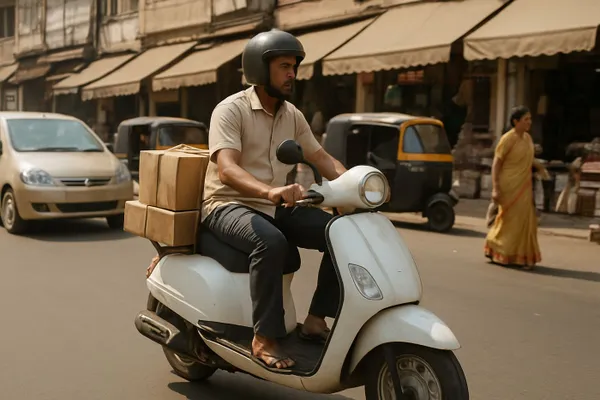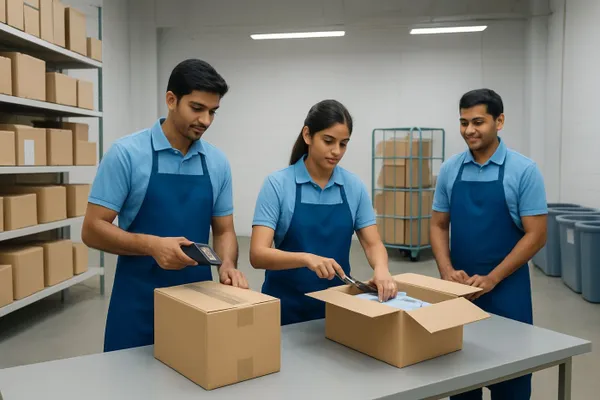
An online order should ship from the store that can fulfil it fastest, cheapest and without hurting that store's walk-in sales. Most Indian retailers let the system pick the first store that shows stock, and that one default quietly causes late deliveries, cancellations and oversold shelves.
This post is about the decision that happens before everything else in fulfilment: which location gets the order. Once you get that rule right, the problems covered in our posts on stores that ignore online orders and on capping online orders per store at peak hours become much rarer, because fewer orders land in the wrong place to begin with.
Why does the first store with stock usually give the wrong answer?
Because "has stock" only tells you a unit exists, not whether that store can ship it today. The first match is often a store with one piece left, a shop that is about to close, or a branch two states away from the customer.
Consider a shirt that sits in three stores. One has a single piece on the rack, one has fourteen, one has nine. If the system simply walks the store list in alphabetical or creation order, the store with one piece gets the order. A walk-in customer picks up that same piece an hour later. The store now has an online order it cannot pack, a staff member who has to explain it, and a customer who gets a cancellation email.
Three failures repeat across chains:
- Last-piece sourcing: the order goes to a store holding one unit, which then sells to a walk-in first.
- Distance blindness: the order ships from a store far from the pincode, so freight and delivery time both rise.
- Busy-store blindness: the order goes to the store already buried in pending orders, where it waits behind the others.
What should decide which store gets an online order?
Four factors, ranked: stock depth, distance to the customer's pincode, current workload and the cost of shipping from that location. Each one answers a different way the order can go wrong.
| Rule | What it protects | Where it fails alone |
|---|---|---|
| Nearest to pincode | Delivery time and freight cost | Nearest store may hold one unit and lose it to a walk-in |
| Deepest stock | Order is unlikely to be cancelled | Deepest store may be far away, so freight eats the margin |
| Lightest workload | Packing and dispatch speed | Light store may be small, slow or far from the customer |
| Lowest shipping cost | Margin on low-value orders | Cheapest lane may be the slowest |
No single rule wins. A good setup combines them in a fixed order: filter out stores that cannot ship, then rank what remains.
How do you keep walk-in customers from taking the stock you promised online?
Reserve the unit the moment the order is accepted, and keep a small store-level floor for items with only a few pieces. A reservation takes the unit out of the sellable count at the till as well as online.
Without a reservation, an accepted order is only a hope. The unit still shows on the counter system, so a billing staff member sells it. With a reservation, the counter sees one less piece. For fast-moving items with one or two pieces per store, many retailers also set a rule that such a store is skipped for online sourcing entirely, because the risk of a lost sale in the shop and a cancelled order online outweighs the benefit. The post on launching an online store without losing walk-in sales explains the protection logic in more detail.
How to set sourcing rules for online orders
Set the rules in a fixed order so that every order goes through the same checks. Here is a sequence that works for a chain with three to thirty stores.
- List every location that can ship online orders and mark the ones that cannot, such as stores without packing space or a courier pickup.
- Set a minimum stock floor per item, so a store holding one or two pieces of a fast seller is skipped for online orders.
- Map each store to the pincodes it serves quickly, then rank eligible stores by distance to the delivery pincode.
- Cap pending online orders per store, so a store above its limit drops down the ranking until it clears its queue.
- Add a fallback: if the top store does not accept within a set time, the order moves to the next store automatically.
- Review the results weekly: cancellations by store, delivery time by store and freight cost per order.
The order matters. Filters (can this store ship at all, does it have enough depth) come before rankings (nearest, lightest). If you rank first and filter later, the best-ranked store keeps getting orders it cannot fill.
Should one store ship the whole order or should it be split?
Ship from one store whenever possible, and split only when the saving or the delivery promise justifies two parcels. A split order means two packing jobs, two freight charges and two chances for something to go wrong.
A simple test is whether one store can cover at least most of the order value within the promised delivery date. If yes, send it there and let the missing line follow, or tell the customer clearly. If no store can cover most of it, splitting is reasonable. Our post on handling split orders without losing margin covers how to cost that decision.
How do stores that are far apart affect tax and transfers?
When stores sit in different states or under different GST registrations, the store that ships the goods must raise the tax invoice for that supply, so sourcing is also a compliance decision. The official CBIC GST portal and the GST portal carry the rules on registration and invoicing, and your tax advisor should confirm how they apply to your set-up.
Two practical points follow. First, an order shipped from a store in another state may change the tax treatment of that sale, so sourcing rules should know which registration each store belongs to. Second, moving stock between stores to fix a lopsided inventory is a separate flow with its own paperwork and its own risk of loss, which is why checking transfers at the loading bay matters.
What does good sourcing look like once it is running?
You will see fewer cancellations on orders that were accepted, shorter gaps between order and dispatch, and lower freight per order. The data to watch is simple and sits in any order system that records the store on each order.
- Cancellation rate by fulfilling store: a store above the chain average is probably being given last-piece orders.
- Time from order to pack: a store that is consistently slow needs a lower cap or a staffing fix.
- Freight per order by lane: a lane that costs far more than neighbouring ones suggests a sourcing rule that ignores distance.
- Walk-in stockouts after reservations: if the shop still runs out, the floor is set too low.
Retail in India is growing across formats, and industry bodies such as IBEF and the Retailers Association of India track that shift towards omnichannel selling. The more channels a chain adds, the more each order's first decision matters. Commmerce, an Omnichannel Retail Operating System for Indian retailers, treats that decision as a set of rules the retailer controls instead of a default hidden in the software.
For a wider view of how chains organise this, see our buyer's guide to multi-store retail software and the guide on setting up click and collect, where the pickup store is chosen by the customer instead of the system.
Frequently asked questions
Should the nearest store always fulfil an online order?
No. The nearest store is a good default only when it holds enough stock to survive a walk-in sale and has capacity to pack today. Otherwise the next nearest store usually delivers sooner in practice.
How many pieces should a store hold before it can be used for online orders?
It depends on how fast the item sells, but a floor of two to three pieces for fast movers is a common starting point. Slow items can ship from the last piece because the walk-in risk is low.
What happens if the chosen store does not accept the order?
The order should move to the next ranked store after a fixed time limit, and the first store should be flagged so you can see how often it happens. Repeated misses mean the cap or staffing needs attention.
Is it better to ship from a warehouse or from stores?
If a warehouse holds the item and is reasonably close, it usually packs faster and protects store stock. Stores work best as a second source for items the warehouse lacks and for customers close to a store.