Why does a "delivered" status not protect you from a "not received" claim?
A delivered status only tells you what the courier or rider recorded, not what the customer experienced. When a buyer says the parcel never arrived and you hold nothing but that status, you usually lose the argument, the refund and the stock.
This is a quiet leak for Indian retailers who sell online. The order was packed correctly, handed over on time and marked delivered. Weeks later it becomes a refund, a courier dispute or a chargeback, and nobody can say who is right. The fix is not more courier tracking. It is collecting proof at the door and keeping it on the same record as the order.
Where do not received disputes actually come from?
Most disputes trace back to four moments: a delivery marked complete without the customer present, a parcel left with a neighbour or guard, a genuine failed attempt closed as delivered, and a customer who simply wants a free product. You cannot tell these apart without evidence.
- Rider closes the task early. Delivery partners are often measured on completed drops, so the status gets tapped before the handover or at the gate.
- Parcel left with someone else. A security desk, a neighbour or a shop next door accepts it and the buyer never hears.
- Genuine misdelivery. A wrong or incomplete address sends the parcel to the wrong flat. Our guide on fixing wrong addresses before dispatch covers how to prevent that upstream.
- Opportunistic claims. A small share of buyers claim non-receipt knowing most sellers will refund rather than argue.
Each case needs a different response, and only proof lets you pick the right one.
What does a refund without proof really cost you?
A refund without proof costs the product, the outbound shipping, the pick and pack labour and often a second chance of a bad review. If the parcel truly was delivered, you also lose the stock for good.
Add the courier side. A shipment closed as delivered cannot be raised as lost, so the claim route described in our post on recovering money on lost and damaged parcels is shut. You pay the customer, you cannot claim from the courier, and the unit is gone. Compare that with a failed attempt you catch early: the NDR process can still bring the parcel back or get it delivered.
What counts as good proof of delivery?
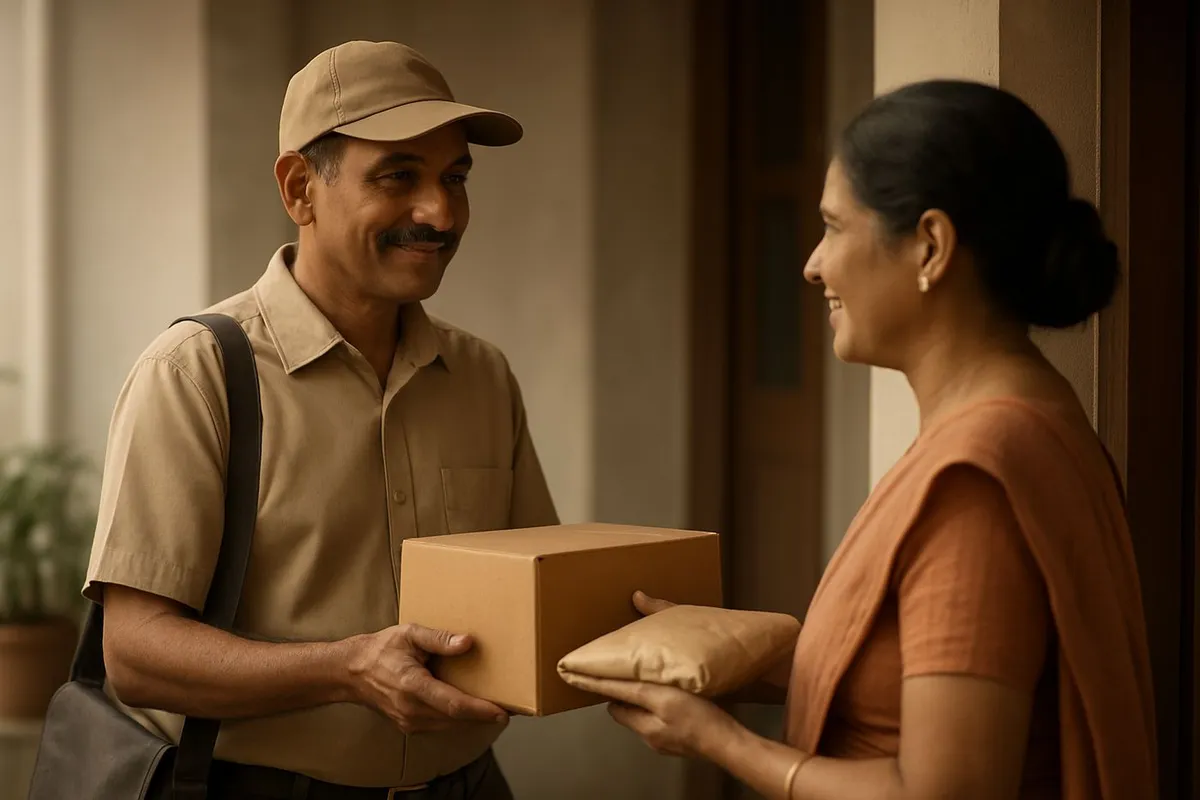
Good proof is something a third party can check and the customer cannot easily fake: a one time code the customer reads out, a timestamped photo at the delivery location, or a signature. Any one of these beats a bare status.
| Proof type | What it shows | Weakness |
|---|---|---|
| Delivery OTP | The customer personally gave a code at handover | Customer must be reachable; works best with a mobile number on the order |
| Geo-tagged photo | Parcel at the door or with the recipient at a place and time | Photo quality varies; shows the door, not always the person |
| Signature | A named person accepted it | Hard to read; easy to scribble |
| Status only | The partner says it is done | No evidence either way |
Use more than one for high value orders. For low value cash on delivery drops, an OTP alone is usually enough.
How to build a proof of delivery process
You can set this up in a week without changing your courier mix. The idea is to make proof a required step, then store it where your support team can find it in seconds.
- Decide which orders need which proof, for example OTP for everything and OTP plus photo above a value you choose.
- Collect a working mobile number at checkout and send the delivery code by SMS or WhatsApp on the day of dispatch.
- Brief your own riders and ask courier partners which proof they capture, because many already offer OTP delivery as an option.
- Require the rider to capture the photo or code before they can close the drop.
- Attach the proof, the timestamp and the rider name to the order record rather than a chat group or phone gallery.
- Review disputed and unproven deliveries every week and flag riders or pincodes with repeated cases.
How do you answer a "not received" claim quickly?
Answer within the same day and lead with the evidence: share the timestamp, photo or code confirmation and ask the customer to check with family, neighbours or the building desk. Most genuine mix ups end there.
If the evidence is weak or missing, treat it as a courier or rider failure and not as the customer's fault. Raise it with the partner while the window is still open, and only then decide on a refund. Keep a short script for the support team so the tone stays polite whatever the outcome.
What about cash on delivery orders?
Cash on delivery needs proof twice, once for the handover and once for the money. A rider who collects cash and marks the order delivered creates two records that must agree, and when they do not, you need the proof to find out which side slipped.
Pair proof of delivery with the remittance checks in our guide to fixing COD reconciliation losses. If you run your own riders, the trade offs in own fleet or courier aggregator help you decide how much control you want.
Which paperwork must travel with the goods?
Goods in transit in India must carry the right documents, usually a tax invoice or delivery challan, and an e-way bill when the consignment value crosses the notified limit. Check the current rules on the CBIC GST portal and keep copies with the order.
These documents prove what was sent. Proof of delivery proves where it ended up. Together they make a dispute much easier to close, whether it is with a customer, a courier or a tax officer.
How should you measure it?
Track three numbers each week: delivered orders with proof as a share of all delivered orders, "not received" claims as a share of delivered orders, and the share of those claims you could answer with evidence. If the first rises, the second and third should follow.
Online retail keeps growing, as IBEF regularly reports for the Indian market, and the Retailers Association of India keeps pointing to operational discipline as what separates margin from leakage. Proof at the door is one of the cheapest bits of discipline to add.
Where does Commmerce fit?
Commmerce is an Omnichannel Retail Operating System for Indian retailers. It does not make couriers capture better proof, but it keeps the order, its dispatch and handover events and its stock on one record, so support is not hunting across a courier portal, a chat group and a spreadsheet. That is where the time and the disputes get lost. For the wider picture, see our look at how order cancellations strand stock, which shows how a single unresolved order can hide sellable inventory.
Whatever tools you use, the rule is the same: no proof, no closed delivery.