Top 10 Self-Checkout Systems for Indian Supermarkets
Table of Contents
- Introduction
- Quick Comparison Table
- 1. Commmerce Self Checkout
- 2. NCR Self Checkout
- 3. Diebold Nixdorf Storevision
- 4. Toshiba TCx Self Checkout
- 5. Posist Self-Order Kiosk
- 6. GoFrugal Self Checkout
- 7. Mswipe KioskPay
- 8. Pine Labs Kiosk Terminal
- 9. PointOne Self Checkout
- 10. WOOSTORE Smart Kiosk
- How to Choose the Right Option for Your Store
- Conclusion
- FAQs
TL;DR
- Self-checkout systems for Indian supermarkets vary widely, from enterprise hardware by NCR and Diebold Nixdorf to app-first kiosk solutions built for mid-size Indian retailers.
- Key features to prioritise for Indian supermarkets include UPI QR payment support, offline-first operation, GST-compliant receipts, and direct integration with your inventory platform.
- Commmerce Self Checkout is the only option on this list built natively on an Omnichannel Retail OS, giving Indian retailers a unified view of in-store orders, online orders, and inventory from a single dashboard.
- Hardware costs, integration depth, and offline reliability differ significantly across vendors, so matching the system to your existing tech stack matters as much as the kiosk features themselves.
Introduction: Self-Checkout Systems for Indian Supermarkets in 2026
Self-checkout systems for Indian supermarkets have moved from a premium experiment to a practical necessity. As footfall increases and labour costs rise, retailers across grocery, pharmacy, and general merchandise are deploying customer-facing kiosks to reduce billing queues, free up staff, and speed up the shopping experience. According to industry estimates, Indian organised retail is growing steadily, and checkout bottlenecks are one of the top friction points shoppers report at physical stores.
This list covers ten real, named self-checkout and self-service kiosk products available in the Indian market in 2026. We evaluated each on UPI payment support, offline capability, integration with retail management software, hardware requirements, and suitability for Indian supermarkets running anywhere from one to fifty stores. Whether you run a neighbourhood grocery or a regional supermarket chain, this guide will help you shortlist the right system for your store.
Quick Comparison Table
| Product | Best For | Standout Feature | Pricing Model |
|---|---|---|---|
| Commmerce Self Checkout | Multi-store Indian retailers on Commmerce OS | Offline-first, UPI QR, full omnichannel sync | Contact pricing |
| NCR Self Checkout | Large-format supermarkets and hypermarkets | Proven global hardware platform | Custom enterprise pricing |
| Diebold Nixdorf Storevision | Enterprise grocery and hypermarket chains | Modular hardware and software stack | Custom enterprise pricing |
| Toshiba TCx Self Checkout | High-volume supermarket chains | Dual-screen attended and unattended modes | Custom enterprise pricing |
| Posist Self-Order Kiosk | Food retail and quick-service formats | Menu-driven ordering with payment integration | Contact pricing |
| GoFrugal Self Checkout | SMB Indian supermarkets using GoFrugal POS | Native integration with GoFrugal ERP | Contact pricing |
| Mswipe KioskPay | Retailers needing payment-first kiosk terminals | UPI, card, and wallet payments on one device | Device rental + transaction fees |
| Pine Labs Kiosk Terminal | Stores wanting integrated card and UPI payment | India's largest card terminal network | Device pricing + MDR |
| PointOne Self Checkout | Tech-forward specialty and grocery retailers | Cloud-native POS with self-serve extension | Contact pricing |
| WOOSTORE Smart Kiosk | Indian retailers looking for a local kiosk vendor | Customisable Android kiosk with local support | Contact pricing |
1. Commmerce Self Checkout
Commmerce Self Checkout is a Flutter-based customer-facing kiosk application built as part of the Commmerce Omnichannel Retail Operating System for Indian retailers. Unlike standalone kiosk products, it connects directly to the Commmerce POS backend for real-time catalog sync, order submission, and payment reconciliation, meaning the kiosk is not a separate silo but a live extension of your entire retail operation. It is designed specifically for Indian supermarkets and multi-format stores that want to reduce billing queues without adding staff or counters.
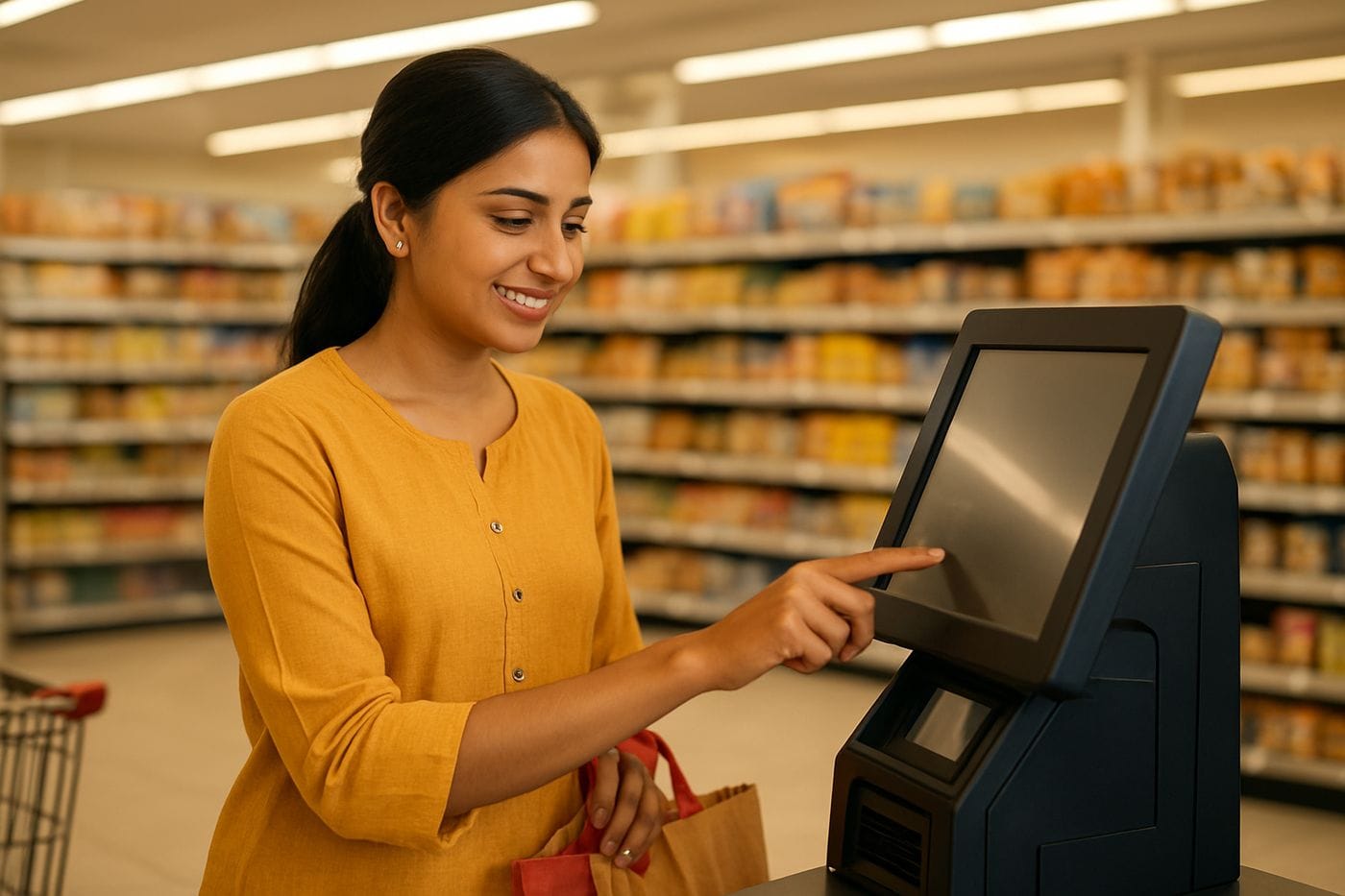
What sets it apart is the combination of offline-first architecture, native UPI payment via Razorpay QR, and full integration with the broader Commmerce platform covering online store, inventory, order management, and delivery. Customers walk up to the kiosk, browse the full product catalog, scan items with a USB barcode scanner, apply loyalty points or coupons, and pay via UPI QR or a Pine Labs card terminal, all without any staff involvement.
Key features:
- Offline-first catalog browsing via local SQLite database, with orders queued and synced automatically when connectivity returns
- Native UPI QR payment via Razorpay and card payment via Pine Labs terminal (USB wired or cloud push)
- Multi-language support with a language selector built into the kiosk flow for Indian regional languages
- Android kiosk lockdown mode (screen pinning or Device Owner) so customers cannot exit the app, plus USB thermal receipt printing
Best for: Indian retailers with 1 to 50 stores across grocery, pharmacy, fashion, or electronics who are already on, or looking to adopt, the Commmerce Omnichannel Retail OS.
Pricing: Contact pricing. Requires Commmerce POS backend.
💡Pro TipIf you are evaluating self-checkout kiosks for a supermarket with multiple branches, choose a system that syncs catalog and orders back to a central platform. A standalone kiosk that does not talk to your inventory will create stock mismatches within days.
2. NCR Self Checkout
NCR (now NCR Voyix) is one of the most recognised names in global retail technology and its self-checkout hardware has been deployed in large-format supermarkets and hypermarkets across India, including in major organised retail chains. The NCR self-checkout range covers both attended and fully unattended configurations, with integrated weighing scales, multi-payment acceptance, and robust cashier-assist features for age-restricted or flagged items. NCR's systems are typically deployed as part of a broader NCR Emerald or NCR POS ecosystem rollout.
Key features:
- Attended and unattended self-checkout configurations with cashier-assist escalation
- Integrated weighing scales for fresh produce and loose-item billing
- Multi-payment support including card, UPI, and cash recycling options on select models
- Central management console for monitoring all kiosks across a store network
Best for: Large-format supermarkets and hypermarket chains with significant capital budgets and existing NCR POS infrastructure.
Pricing: Custom enterprise pricing. Contact NCR Voyix India directly.
3. Diebold Nixdorf Storevision
Diebold Nixdorf is a global retail and banking technology company with a strong presence in Indian organised retail. Their Storevision self-checkout platform offers a modular hardware and software stack that can be configured for grocery, hypermarket, and general merchandise formats. The system supports a range of payment methods and can integrate with existing retail ERP systems via APIs. Diebold Nixdorf's kiosks are built for high-transaction-volume environments where reliability and uptime are non-negotiable.
Key features:
- Modular hardware design allowing retailers to configure screen size, scanner type, and payment peripherals
- Support for cash, card, and digital payment modes
- ERP and POS integration via open APIs
- Remote monitoring and diagnostics for multi-store kiosk fleets
Best for: Enterprise grocery and hypermarket chains with IT teams capable of managing complex hardware-software integration projects.
Pricing: Custom enterprise pricing. Contact Diebold Nixdorf India for a quote.
⚠️Watch OutEnterprise self-checkout hardware from global vendors like NCR and Diebold Nixdorf often requires multi-month implementation timelines and dedicated IT resources. Mid-size Indian supermarkets should factor in total cost of ownership, not just device price, before committing.
4. Toshiba TCx Self Checkout
Toshiba's TCx Self-Checkout range is a well-established retail technology product used in supermarket chains globally and present in the Indian market through Toshiba Global Commerce Solutions. The TCx line offers both compact and full-sized units designed for grocery and general merchandise environments, with dual-screen configurations that allow an associate to assist at the same terminal used by a self-serve customer. Toshiba's software platform supports a wide range of peripheral integrations including scales, scanners, and payment terminals.
Key features:
- Dual-screen attended and unattended mode on the same unit, reducing hardware investment for stores that mix both models
- Integrated bagging area weight sensors to detect scan-and-bag discrepancies
- Multi-payment terminal integration including card and contactless
- TCx Software suite for centralised store system management
Best for: High-volume supermarket chains looking for a globally proven hardware platform with flexible deployment modes.
Pricing: Custom enterprise pricing. Contact Toshiba Global Commerce Solutions India.
5. Posist Self-Order Kiosk
Posist is an Indian cloud restaurant and retail technology platform that has expanded its kiosk offering to include self-order terminals for food retail and quick-service grocery formats. The Posist self-order kiosk integrates with the broader Posist platform, which covers order management, kitchen display systems, and analytics. While Posist's roots are in food service, its kiosk product is relevant for Indian supermarkets that operate prepared food, bakery, or café sections alongside their core grocery floor. According to IBEF's retail India industry report, food and grocery remain the dominant category in Indian organised retail, making hybrid kiosk solutions increasingly relevant.
Key features:
- Menu-driven self-ordering flow optimised for food and grocery item categories
- Integration with kitchen display systems for prepared food sections
- UPI and card payment support via integrated payment partners
- Real-time order tracking and centralised reporting across outlets
Best for: Supermarkets or grocery formats with a significant food-to-go or prepared food section, or retailers already on the Posist platform.
Pricing: Contact pricing. Posist operates on a SaaS model; hardware costs are separate.
6. GoFrugal Self Checkout
GoFrugal is a Chennai-based retail ERP and POS software company with a strong base among Indian supermarkets, pharmacies, and grocery stores. GoFrugal offers a self-checkout kiosk extension as part of its broader retail management suite, designed to work natively with GoFrugal POS and inventory modules. For retailers already running GoFrugal for their billing and stock management, the self-checkout module reduces the integration complexity significantly. The system supports barcode scanning, loyalty redemption, and digital payment modes.
Key features:
- Native integration with GoFrugal POS and inventory for real-time catalog and stock sync
- Customer loyalty point redemption at the kiosk
- Barcode scanning with support for standard USB hardware scanners
- GST-compliant receipt generation aligned with GoFrugal's billing engine
Best for: Small and mid-size Indian supermarkets and grocery stores that are already using GoFrugal as their core retail management platform.
Pricing: Contact GoFrugal India for module pricing. Core GoFrugal ERP starts from approximately ₹3,000 to ₹10,000 per month depending on configuration.
7. Mswipe KioskPay
Mswipe is a leading Indian fintech company known primarily for its payment terminal devices. The Mswipe KioskPay offering is a payment-focused kiosk solution that consolidates UPI, card (debit and credit), and wallet payments onto a single Android-based device. While KioskPay is more of a payment acceptance terminal with a kiosk interface than a full retail self-checkout system, it serves a real need for Indian supermarkets that want to add unmanned payment points without deploying a full kiosk stack. It is commonly used as a queue-busting payment station at express checkout lanes.
Key features:
- UPI QR, card (swipe, chip, tap), and mobile wallet acceptance on one device
- Android-based OS with customisable merchant interface
- Transaction reporting via Mswipe merchant dashboard
- Compact form factor suitable for counter-top or wall-mount deployment
Best for: Indian supermarkets that want to add unmanned payment points or express checkout lanes without deploying a full kiosk catalog system.
Pricing: Device rental model plus per-transaction MDR. Contact Mswipe India for current device pricing.
8. Pine Labs Kiosk Terminal
Pine Labs is India's largest merchant commerce platform and its Plutus payment terminals are the most widely deployed card acceptance devices in Indian retail. Pine Labs has expanded beyond traditional payment terminals into kiosk-format deployments through its Plutus Smart and cloud-connected terminal range. For supermarkets, a Pine Labs kiosk terminal acts as a payment station that can be integrated into self-checkout software stacks, including Commmerce Self Checkout, which supports Pine Labs terminals natively via USB wired and cloud push modes. The Razorpay-Pine Labs ecosystem also provides a unified payment layer for Indian retailers managing both UPI and card transactions.
Key features:
- Card (swipe, chip, contactless), UPI, and EMI payment acceptance across India's major acquiring banks
- Cloud push payment initiation, allowing software to trigger payment on the terminal remotely
- Plutus API for integration with third-party kiosk and POS software
- Widely available across India with strong support network
Best for: Supermarkets looking for a reliable card and UPI payment peripheral to integrate with their chosen self-checkout software platform.
Pricing: Device pricing varies by model plus applicable MDR on transactions. Contact Pine Labs India.
9. PointOne Self Checkout
PointOne is an Indian cloud-native retail technology company building modern POS and self-checkout tools for specialty and grocery retailers. PointOne's self-checkout offering is designed as an extension of its cloud POS platform, targeting tech-forward Indian retailers who want a modern, API-first approach to in-store checkout. The platform supports multi-store management, real-time inventory visibility, and digital payment integration, positioning it as an alternative to legacy on-premise systems for growing Indian supermarket chains. PointOne competes in the same mid-market segment as GoFrugal and Commmerce.
Key features:
- Cloud-native POS with a self-checkout kiosk extension for customer-facing transactions
- Real-time inventory sync across branches via the PointOne cloud platform
- Digital payment integration including UPI and card terminals
- Multi-store dashboard for centralised performance monitoring
Best for: Tech-forward specialty or grocery retailers who want a modern, API-first retail stack and do not need deep offline capability.
Pricing: Contact PointOne India for current pricing. SaaS model with hardware costs separate.
10. WOOSTORE Smart Kiosk
WOOSTORE is an Indian kiosk hardware and software vendor offering Android-based self-service kiosk solutions for retail, hospitality, and services sectors. The WOOSTORE Smart Kiosk is a customisable kiosk product that combines Android tablet hardware with a configurable kiosk application, allowing retailers to deploy a self-service browsing and payment station without the enterprise price tag of global hardware vendors. WOOSTORE offers local installation support and hardware maintenance across major Indian cities, which is a practical advantage for smaller supermarket chains that need reliable on-ground service.
Key features:
- Customisable Android kiosk application with retail catalog and cart flow
- UPI QR and card payment acceptance via integrated payment partners
- Kiosk lockdown mode to prevent customers from exiting the app
- Local hardware support and maintenance across major Indian metros
Best for: Small and mid-size Indian supermarkets or standalone grocery stores looking for a locally supported kiosk product at a more accessible price point.
Pricing: Contact WOOSTORE India. Pricing is typically a combined hardware plus software fee.
How to Choose the Right Self-Checkout Kiosk for Your Supermarket
Choosing the right self-checkout system for your Indian supermarket comes down to four practical criteria that will determine whether the kiosk actually reduces queues or just adds a maintenance headache.
1. Integration with your existing retail platform
A kiosk that does not talk to your POS and inventory in real time will create stock mismatches and order reconciliation problems within days. Prioritise systems that offer native integration with your current retail management software. If you are already on Commmerce, GoFrugal, or Posist, use their own kiosk modules. If you are evaluating a new platform, choose one where the kiosk is built into the same product suite rather than bolted on via a third-party integration.
2. Offline reliability
Internet connectivity in Indian retail stores, particularly in tier-2 and tier-3 cities, can be inconsistent. A self-checkout kiosk that stops working when the internet drops is worse than no kiosk at all. Look for offline-first architecture, where the product catalog is stored locally and orders are queued for sync. Commmerce Self Checkout uses a local SQLite database for exactly this reason, and it is a feature worth specifically asking any vendor to demonstrate before signing a contract.
3. Payment methods supported
UPI is the primary payment method for Indian retail customers. Any self-checkout kiosk deployed in an Indian supermarket in 2026 must support UPI QR payments natively. Card support via Pine Labs or a similar network is useful for higher-value baskets. Refer to RBI payment system data to understand just how dominant UPI has become in Indian consumer payments. Vendors that support only card or cash payments will frustrate customers and reduce adoption rates.
4. Hardware cost and local support
Enterprise kiosk hardware from NCR, Diebold Nixdorf, or Toshiba delivers reliability but comes with significant capital investment and long implementation timelines. For Indian supermarkets in the 1 to 50 store range, Android tablet-based kiosk software running on commodity hardware offers a faster, more affordable path to deployment. Factor in not just device cost but also on-ground support availability, spare parts, and software update mechanisms before making a final decision.
Running a retail business in India? See how Commmerce unifies your stores, inventory, orders and delivery in one platform.
Conclusion
The best self-checkout systems for Indian supermarkets in 2026 are not just kiosk hardware. They are software-first, payment-native, and deeply integrated with the retail management platform behind the counter. Enterprise vendors like NCR, Diebold Nixdorf, and Toshiba serve large-format chains with complex requirements and significant IT budgets. For the majority of Indian supermarkets running one to fifty stores, the stronger choices are systems built around UPI payments, offline-first operation, and direct integration with inventory and order management. GoFrugal and Posist work well if you are already inside their ecosystems. Commmerce Self Checkout stands out as the option designed from the ground up for the Indian mid-market, where the kiosk is one part of a unified omnichannel retail operating system rather than a standalone device. Whichever system you choose, the criteria are consistent: does it work without internet, does it accept UPI, and does it talk to your inventory in real time.
FAQs
Q: What is a self-checkout system for supermarkets?
A: A self-checkout system is a customer-facing kiosk or terminal that lets shoppers scan their own items, add them to a cart, and pay without needing a cashier, reducing queues and freeing up store staff for other tasks.
Q: Do self-checkout kiosks in India support UPI payments?
A: Yes, several self-checkout systems available in India support UPI QR code payments. Commmerce Self Checkout, for example, generates a Razorpay UPI QR at the kiosk so customers can pay instantly using any UPI app.
Q: Can a self-checkout kiosk work without internet in India?
A: Offline capability varies by product. Commmerce Self Checkout uses a local SQLite database to serve the full product catalog without internet, and queues orders to sync automatically once connectivity is restored.
Q: How much does a self-checkout system cost in India?
A: Pricing varies widely across providers. Enterprise hardware vendors like NCR and Diebold Nixdorf use custom pricing, while app-layer solutions may charge a monthly SaaS fee. Budget separately for any required hardware such as tablets, barcode scanners, or card terminals.
Q: Which self-checkout system is best for a mid-size Indian supermarket?
A: For Indian supermarkets running multiple stores, a system that combines offline-first operation, UPI payments, and direct integration with your existing inventory and order management platform will deliver the best results. Commmerce Self Checkout is built specifically for this use case on the Commmerce Omnichannel Retail OS.
Disclaimer: This article is for general informational purposes only and does not constitute legal, financial, or tax advice. GST rules, compliance requirements, and platform features may change over time. Please verify the latest guidelines with a qualified professional or refer to official sources such as the GSTN or CBIC. Market statistics mentioned are based on publicly available estimates and may not reflect current figures. Commmerce product features referenced are accurate at the time of writing and subject to change.