Warehouse Receiving Errors: How Indian Grocery Chains Lose Crores
Table of Contents
- Introduction
- The Hidden Cost of Receiving Errors in Indian Grocery Retail
- The Most Common Warehouse Receiving Errors Indian Grocery Chains Make
- What to Look for in a Warehouse Receiving Solution
- How to Fix Warehouse Receiving Errors in Your Grocery Chain
- How Commmerce Helps Indian Grocery Chains Eliminate Receiving Losses
- Conclusion
- FAQs
TL;DR
- Warehouse receiving errors in Indian grocery chains silently drain crores every year through unrecorded short shipments, wrong SKU entries, and stock mismatches between branches.
- Manual GRN processes, disconnected billing tools like Tally or Marg ERP, and the absence of barcode scanning at the dock are the root causes of most receiving losses.
- A unified omnichannel retail platform with real-time inventory sync, barcode and RFID receiving, and automated GRN workflows is the most effective way to eliminate these errors at scale.
- Commmerce is an Omnichannel Retail Operating System that connects warehouse receiving, inventory, POS, and OMS in one platform so grocery chains can see and control stock across every branch in real time.
Introduction
Warehouse receiving errors are quietly draining crores from Indian grocery chains every single month. When a truck pulls up at the loading dock and staff manually count cartons, scribble quantities on paper, and key them into a disconnected billing system hours later, the margin for error is enormous. A missing case of cooking oil here, a wrong SKU entered for basmati rice there, and by the time a branch manager notices the discrepancy, the supplier has been paid in full and the stock is already sold or worse, missing entirely.
This post breaks down exactly how receiving errors happen, what they cost multi-branch grocery retailers across India, and the practical steps and systems that stop the bleeding for good.
The Hidden Cost of Receiving Errors in Indian Grocery Retail
Warehouse receiving errors in grocery retail are not a minor operational inconvenience. They compound across every branch, every delivery cycle, and every supplier relationship until they represent a significant and measurable loss of revenue.
Consider a grocery chain running 10 branches across a single city. Each branch receives stock from 20 to 30 suppliers multiple times per week. If just 1% of received quantities are recorded incorrectly at each dock, the inventory system becomes increasingly unreliable. The store sells what it thinks it has, runs out before the system says it should, over-orders from the supplier to compensate, and pays for stock it cannot account for. According to industry estimates, grocery retailers can lose between 1% and 3% of total inventory value annually to receiving discrepancies, short shipments, and unrecorded stock variances alone.
The problem is compounded by the tools most Indian grocery chains currently rely on. Disconnected systems like TallyPrime, Marg ERP, or manual Excel sheets were not built for real-time multi-branch inventory control. A purchase order raised in Tally does not automatically sync with the physical count happening at the warehouse dock. A supplier short-ships 10 cartons, the receiving staff does not notice because they are under pressure to clear the dock quickly, and the GRN is filed as complete. The inventory system now shows 10 phantom cartons of stock that do not exist. When that stock is sold at the POS, the system records a sale against inventory that was never there, creating a negative stock balance that nobody can explain at month end.
For context on the scale of India's grocery retail market and the importance of operational accuracy, the India Brand Equity Foundation's retail industry report highlights that grocery and food retail is one of the largest and fastest-growing segments in Indian organised retail, making operational losses in this category especially consequential.
⚠️Watch OutIf your GRN process relies on staff manually keying received quantities into a billing tool after the truck has left, you are almost certainly paying suppliers for stock you never actually received.
The Most Common Warehouse Receiving Errors Indian Grocery Chains Make
Most warehouse receiving errors in Indian grocery chains fall into a small number of predictable patterns. Identifying them is the first step toward eliminating them.
Short Shipments Accepted Without Verification
Suppliers sometimes ship fewer units than invoiced, whether due to logistics constraints, stock shortages at their end, or deliberate underfilling. Without a barcode scan of every item against the purchase order at the receiving dock, receiving staff have no reliable way to catch this in real time. The GRN is filed as complete, the supplier invoice is cleared, and the grocery chain has paid for stock it never received.
Wrong SKU or Wrong Variant Entered in the System
Grocery inventory is dense with near-identical SKUs. A 1-litre pack and a 500ml pack of the same brand of refined oil may look similar on the shelf but carry very different purchase prices and selling prices. When receiving staff key in quantities manually without scanning, the wrong SKU is entered, creating a ghost stock for one variant and a shortage for the other. This error compounds every time the item is sold, received, or transferred between branches.
Receiving Against No Purchase Order
In many smaller grocery chains, suppliers arrive unannounced or with a partial shipment that does not match any open PO. Staff accept the delivery to avoid conflict, raise a manual GRN, and the stock enters the system outside any controlled purchase workflow. This makes it impossible to reconcile what was ordered, what was received, and what was paid for.
No Real-Time Sync Between Warehouse and Branch Inventory
Even when a GRN is filed correctly at the warehouse, if the inventory system does not update branch stock levels in real time, the branch POS continues to show stale numbers. This leads to overselling, stockouts that the system does not predict, and inter-branch transfer requests for stock that is already sitting in the warehouse unallocated. This is a structural problem with disconnected tools like Vyapar or Marg ERP, which lack native multi-branch real-time inventory sync.
Damaged or Expired Stock Accepted Into Inventory
Grocery receiving involves perishables and date-sensitive packaged goods. Without a structured receiving workflow that prompts staff to check expiry dates and condition, damaged or near-expiry stock enters the inventory system at full value. It is then counted in stock reports, affects reorder calculations, and is either written off at a loss later or, in the worst case, makes it to the shelf and to the customer.
💡Pro TipEvery GRN your team raises should be matched against an open purchase order in real time at the dock, not reconciled in the back office the next morning when discrepancies are already impossible to prove.
What to Look for in a Warehouse Receiving Solution
The right solution for warehouse receiving errors must connect the physical act of receiving stock at the dock directly to your live inventory system, your purchase orders, and your branch-level stock positions, without any manual re-entry step in between.
Here is what a capable solution for Indian grocery chains must include:
- Barcode and RFID scanning at the receiving dock so every item is verified against the PO before it enters stock.
- Automated GRN generation that creates a Goods Received Note instantly on scan, with discrepancies flagged in real time.
- Purchase order matching so no delivery can be accepted without being tied to an open, approved PO in the system.
- Real-time inventory update across all branches and warehouses the moment a GRN is confirmed, with no manual sync required.
- Putaway workflow that directs received stock to the correct bin, shelf, or storage zone rather than leaving it on the dock floor.
- Damage and expiry recording at the point of receiving, so rejected or short-dated stock is logged before it enters saleable inventory.
- Supplier reconciliation reports that compare what was ordered, what was received, and what was invoiced so disputes can be raised with data.
- Integration with your GST billing and e-invoice system so received stock flows automatically into purchase accounting without double entry.
Tools like Vyapar or TallyPrime handle basic accounting and billing well, but they were not designed as warehouse management systems. They lack dock-side scanning workflows, real-time multi-branch inventory sync, and structured putaway logic. Grocery chains that rely on them for warehouse receiving are essentially running their most error-prone process with the least capable tool in their stack. You can read more about how receiving errors affect adjacent retail categories in our post on Warehouse Receiving Errors Cost Indian Fashion Retailers Crores.
How to Fix Warehouse Receiving Errors in Your Grocery Chain
Fixing warehouse receiving errors in a multi-branch Indian grocery chain requires a combination of process discipline and the right platform. Here is a step-by-step approach that works at scale.
- Standardise purchase order creation before any delivery is accepted. Every supplier delivery must be tied to an approved PO in the system. No PO, no receiving. This single rule eliminates the largest source of uncontrolled stock entry and gives you a clean audit trail for every supplier relationship.
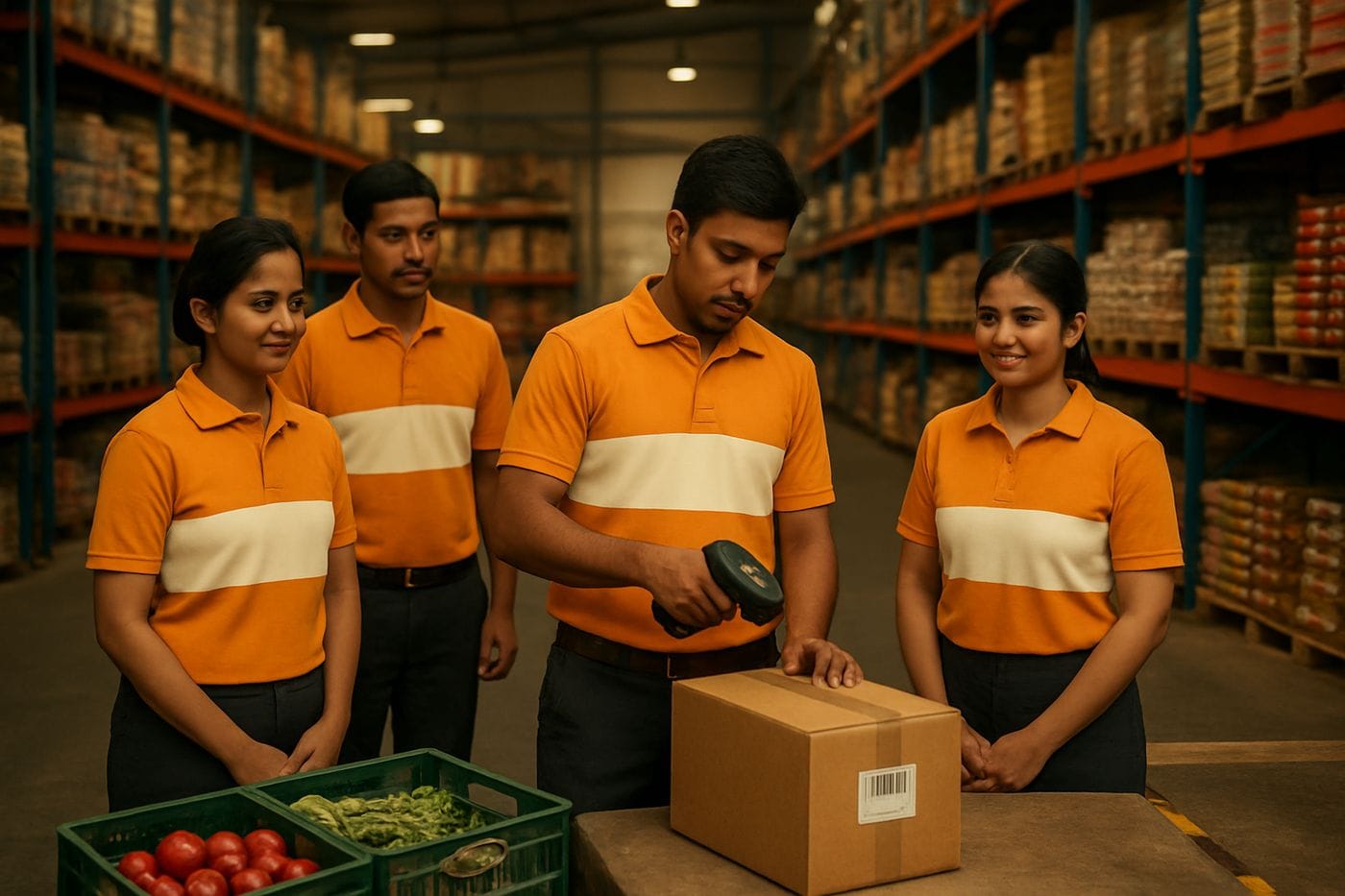
- Deploy barcode or RFID scanning at every receiving dock. Equip your warehouse staff with Android or iOS handheld scanners running your WMS. Every item scanned at the dock is matched against the open PO line in real time. Discrepancies, short shipments, and wrong SKUs are flagged immediately, before the truck leaves and before the GRN is raised.
- Automate GRN generation and inventory update on scan confirmation. When receiving staff confirm a delivery on the handheld device, the system should automatically generate the GRN, update inventory across all connected branches and warehouses in real time, and push the data to your purchase accounting workflow. No manual re-entry, no overnight batch sync.
- Add a damage and expiry check step to the receiving workflow. Build a mandatory screen into your receiving flow that prompts staff to record damaged units and check expiry dates before confirming the GRN. Rejected stock should be logged as a supplier return or damage write-off, not absorbed into saleable inventory.
- Run daily receiving reconciliation reports. Every morning, your warehouse manager should be looking at a report that shows what was ordered versus what was received versus what was invoiced across all branches the previous day. Any variance above a set threshold should trigger an automatic supplier query. This turns a monthly problem into a daily catch.
- Train receiving staff on the workflow, not just the tools. Technology alone does not fix process errors. Staff need to understand why each step matters, what happens downstream when they skip a scan, and how to raise a discrepancy with the supervisor on duty. Role-based access control ensures only authorised staff can confirm GRNs or override a receiving discrepancy.
For grocery chains managing orders across both physical stores and online channels, pairing a strong receiving workflow with a capable OMS is equally important. Read our guide on How Indian Grocery Chains Can Use OMS to Cut Order Errors to understand how unified order management connects to your receiving and inventory operations.
The Central Board of Indirect Taxes and Customs also mandates that stock records used for GST input tax credit claims must accurately reflect actual received quantities. Receiving errors that inflate your recorded inventory can create compliance exposure if your ITC claims do not match actual stock movements.
How Commmerce Helps Indian Grocery Chains Eliminate Receiving Losses
Commmerce is an Omnichannel Retail Operating System built specifically for Indian retailers running 2 to 50 stores. It connects warehouse receiving, inventory management, POS billing, OMS, and delivery fulfilment into a single platform so grocery chains can see and control every unit of stock from the receiving dock to the customer's hands.
Barcode and RFID Based Receiving at the Dock
Commmerce includes barcode and RFID based inventory tracking that works at the point of receiving. Staff scan incoming stock against the purchase order on any Android or iOS device, including affordable generic hardware your team already owns. The platform runs on Windows, Mac, Android, iOS, and web, so there is no need to invest in expensive proprietary scanning terminals. Every scan is matched against the open PO in real time, and discrepancies are flagged instantly before the GRN is confirmed.
Warehouse Management with Picking, Packing, and Putaway Workflows
Commmerce's WMS module includes structured putaway workflows that direct received stock to the correct storage location the moment it is confirmed. This eliminates the common grocery warehouse problem of stock sitting on the dock in an unallocated state, creating phantom inventory in the system while physically accessible to nobody. The same workflow covers picking and packing for outbound fulfilment, connecting your inbound receiving process to your outbound order management in one continuous system.
Centralised Real-Time Inventory Across All Branches and Warehouses
The moment a GRN is confirmed in the Commmerce WMS, inventory levels update in real time across every connected branch and warehouse. There is no nightly batch sync, no manual transfer entry, and no lag between what is physically in the warehouse and what the branch POS sees. This is the core difference between a unified omnichannel retail platform and a set of disconnected tools like Marg ERP or Vyapar patched together with Excel exports.
GST Billing and E-Invoice Integration for Received Stock
Commmerce includes built-in GST billing and e-invoice generation compliant with Indian tax laws, integrated with Tally Prime and the GSTN e-invoice system. When stock is received and the GRN is confirmed, the purchase data flows automatically into your accounting and tax workflow. This eliminates the double-entry problem that causes ITC mismatches and GST filing errors in grocery chains that use separate billing software alongside a warehouse tool.
Role-Based Access Control for Receiving Staff
Commmerce includes staff management with role-based access control, so you can define exactly who can raise a GRN, who can override a discrepancy, and who can approve a supplier return. This reduces staff theft and shrinkage at the receiving dock, one of the most common and least visible sources of inventory loss in grocery retail, by ensuring every receiving action is logged against a specific user with a full audit trail.
You can also explore how Commmerce handles the full POS and billing setup for multi-branch grocery chains in our Grocery POS System India: Complete Setup Guide for Multi-Store Chains.
| Capability | Tally / Marg ERP / Vyapar | Commmerce Omnichannel OS |
|---|---|---|
| Barcode scan at receiving dock | Not available natively | Built-in, works on Android and iOS |
| Real-time multi-branch inventory sync | Manual or batch sync | Real-time across all branches |
| PO-matched GRN workflow | Limited or manual | Automated, flagged in real time |
| Putaway and warehouse workflow | Not available | Picking, packing, and putaway built in |
| GSTN e-invoice integration | Tally has it; Vyapar/Marg limited | Built-in with Tally Prime sync |
| Omnichannel OMS and POS connection | Separate tools required | One unified platform |
Running a grocery chain in India? See how Commmerce unifies your warehouse receiving, inventory, orders, and delivery across every branch in one platform.
Conclusion
Warehouse receiving errors in Indian grocery chains are not random accidents. They are the predictable result of manual GRN processes, disconnected billing tools, and the absence of real-time inventory systems at the receiving dock. For multi-branch grocery retailers doing ₹2 crore to ₹100 crore in annual revenue, these errors compound across every delivery cycle into losses that show up as unexplained shrinkage, GST mismatches, and stock positions that nobody trusts. The fix is a structured receiving workflow backed by barcode scanning, purchase order matching, automated GRN generation, and real-time inventory sync across all branches, all connected in a single omnichannel retail platform rather than a patchwork of billing apps and warehouse spreadsheets. Grocery chains that address receiving accuracy at the system level are the ones that protect their margins and scale without losing control of their stock.
FAQs
Q: What are warehouse receiving errors in grocery retail?
A: Warehouse receiving errors are discrepancies that occur when incoming stock is not accurately counted, verified, or recorded against the purchase order, leading to inventory mismatches, billing disputes, and lost revenue in grocery retail operations.
Q: How much can warehouse receiving errors cost an Indian grocery chain?
A: According to industry estimates, Indian grocery retailers can lose between 1% and 3% of their total inventory value annually due to receiving errors, short shipments, and unrecorded stock discrepancies across branches.
Q: What causes warehouse receiving errors in Indian grocery stores?
A: The most common causes include manual paper-based receiving processes, lack of barcode scanning at the dock, disconnected billing and inventory systems, untrained staff handling GRNs, and no real-time sync between warehouse and store inventory.
Q: How does barcode and RFID scanning help reduce receiving errors?
A: Barcode and RFID scanning at the receiving dock allows staff to match each incoming item against the purchase order in real time, immediately flagging short shipments or wrong SKUs before stock enters the warehouse, which eliminates manual counting errors.
Q: Can Commmerce help grocery chains manage warehouse receiving across multiple branches?
A: Yes. Commmerce is an Omnichannel Retail Operating System that includes warehouse management with picking, packing, and putaway workflows, barcode and RFID based inventory tracking, and centralised inventory visibility across all branches and warehouses in real time.
Disclaimer: This article is for general informational purposes only and does not constitute legal, financial, or tax advice. GST rules, compliance requirements, and platform features may change over time. Please verify the latest guidelines with a qualified professional or refer to official sources such as the GSTN or CBIC. Market statistics mentioned are based on publicly available estimates and may not reflect current figures. Commmerce product features referenced are accurate at the time of writing and subject to change.