Dispatch Management Software for Indian Warehouse Teams: 2026 Guide
Table of Contents
- Introduction
- The Problem Indian Warehouse Teams Face
- What to Look for in Dispatch Management Software
- Key Features Every Warehouse Dispatch System Needs
- How to Evaluate and Switch to a Dispatch Platform
- How Commmerce Delivery Hub Helps Indian Warehouse Teams
- Conclusion
- FAQs
TL;DR
- Dispatch management software for Indian warehouse teams replaces manual carrier portals and spreadsheets with a single dashboard that handles own-fleet riders and third-party couriers together.
- Indian retailers need software built for COD collection, pincode-based zone mapping, and integration with carriers like Delhivery, BlueDart, and India Post.
- Commmerce Delivery Hub lets Indian retailers manage internal fleet dispatch and 12-plus carrier shipments from one platform, with same-day setup and no hardware migration required.
- Tools like Vyapar, Marg ERP, and TallyPrime handle billing but offer no dispatch or last-mile delivery management, leaving warehouse teams without a fulfilment workflow.
Introduction
Dispatch management software for Indian warehouse teams has moved from a nice-to-have to a daily operational necessity. As Indian retail shifts to omnichannel, warehouse teams are no longer just packing boxes. They are coordinating own-fleet riders for local deliveries, booking outstation couriers, tracking COD collections, and keeping customers informed in real time. Doing all of this across separate carrier portals, WhatsApp messages, and Excel sheets creates errors that cost money and customers.
According to the India Brand Equity Foundation (IBEF), India's e-commerce and retail logistics sector continues to scale rapidly, driven by Tier 2 and Tier 3 city demand. That growth is putting pressure on warehouse and dispatch teams that were never built for this volume.
This guide walks through the core problems, the features that matter, how to evaluate and switch platforms, and how Commmerce Delivery Hub solves this for Indian retailers doing 50 to 5,000 deliveries per day.
The Problem Indian Warehouse Teams Face
Indian warehouse and dispatch teams typically deal with three delivery channels at once: their own riders for local same-day orders, courier companies for outstation shipments, and hyperlocal services for same-hour delivery. Each channel runs on a separate system, and stitching them together manually is where things break.
Here is what a typical day looks like without a unified dispatch management system for Indian warehouses:
- Order details are copied by hand from the OMS or POS into carrier portals, one shipment at a time.
- Shipping labels are generated in each carrier's own portal, downloaded, and printed separately.
- Driver assignments happen over WhatsApp with no visibility into who is nearby or available.
- COD collections are recorded in a notebook or a shared spreadsheet, with no reconciliation against actual deposits.
- When a customer calls asking for a status update, the warehouse team has to log into three different carrier dashboards to find out.
- Returns and undelivered orders land back at the store with no structured reverse logistics workflow.
As order volumes grow, this breaks down fast. Missed deliveries, lost COD cash, and driver performance blind spots become daily incidents rather than occasional ones. Retailers using tools like Vyapar, Marg ERP, or TallyPrime get solid billing and accounting, but none of them offer a dispatch workflow, carrier integration, or fleet management. They were not designed for last-mile operations.
For a deeper look at how warehouse process gaps cascade into costly errors, see our guide on Warehouse Receiving Errors: How Indian Grocery Chains Lose Crores.
⚠️Watch OutRetailers who manually copy order details into carrier portals face a compounding error rate. A single transposed pincode or wrong mobile number can trigger an RTO, and the COD money never comes back.
What to Look for in Dispatch Management Software
The right warehouse dispatch management software for Indian retailers must handle both own-fleet operations and multi-carrier shipping in one place. Here is the evaluation framework to use.
1. Unified Fleet and Carrier Management
The single most important requirement is that the platform handles internal riders and external carriers from one screen. Platforms that only do carrier aggregation still leave the own-fleet problem unsolved. Look for real-time GPS tracking for drivers, auto-assignment logic, and proof-of-delivery capture built into the driver app.
2. Indian Carrier Integrations Out of the Box
The dispatch system needs to connect to the carriers your business already uses. For Indian retailers, that means Delhivery, BlueDart, DTDC, Ecom Express, Shiprocket, India Post, Porter, and Shadowfax. Carrier integrations that require custom development work add weeks of delay and create maintenance risk. Opt for a platform where these integrations are pre-built and maintained by the vendor.
3. COD Workflow Built for India
Cash-on-delivery is not a feature in Indian retail, it is the default. Your dispatch software needs a proper COD workflow: driver collects cash, records it in the app, deposits at the store, and the dashboard shows outstanding COD per driver with a reconciliation trail. Partial COD and risk-based COD controls (to reduce RTO on repeat non-delivery customers) are also worth looking for.
4. Pincode-Based Zone Management
Indian delivery pricing and SLAs are structured around 6-digit pincodes. The platform must support pincode-based delivery zone mapping so you can define custom pricing, assign the right carrier or rider per zone, and get automatic SLA alerts when orders breach their delivery window.
5. Customer Tracking and WhatsApp Notifications
Customers in India expect real-time order tracking, increasingly through WhatsApp rather than email. The dispatch system should generate a branded tracking page per shipment and send WhatsApp status updates (Out for Delivery, Order Delivered) without requiring a separate messaging tool.
6. Integration with Your Existing Retail Stack
A dispatch system that does not connect to your POS or OMS creates a new data silo. Look for platforms that integrate with your billing system and online store through standard APIs or webhooks, so orders flow automatically into the dispatch queue without manual entry.
| Capability | Vyapar / Marg ERP / TallyPrime | Commmerce Delivery Hub |
|---|---|---|
| Carrier integrations | None | 12+ carriers including Delhivery, BlueDart, India Post |
| Internal fleet management | None | Real-time GPS tracking, driver app, auto-assignment |
| COD reconciliation | Manual / accounting entry | Per-driver COD dashboard with deposit verification |
| WhatsApp delivery updates | None | Built-in WhatsApp notifications via configurable templates |
| Pincode zone management | None | 6-digit pincode zone mapping with custom pricing and SLA |
💡Pro TipBefore evaluating any dispatch platform, list every carrier you currently use and every delivery method your team handles. A platform that covers 80% of your carriers but ignores your own-fleet riders still leaves you with two systems.
Key Features Every Warehouse Dispatch System Needs
Beyond the evaluation framework, there are specific features that separate a true warehouse dispatch management solution from a basic carrier aggregator. Here is what to look for at the feature level.
Auto-Assignment and Carrier Rate Comparison
Manually choosing between Delhivery and BlueDart for each shipment is not scalable. The system should automatically compare carrier rates and SLAs for each order's pincode and weight, then book the best option. For own-fleet orders, it should auto-assign to the nearest available driver by zone.
Shipping Label and AWB Generation
Every courier has its own label format. The dispatch system should generate carrier-specific shipping labels and manifests in bulk, without the warehouse team ever logging into a carrier portal. For India Post, look for direct CEPT integration with pre-allocated AWB number pools and manifest generation. This is a hard requirement for retailers shipping through government postal channels.
Proof of Delivery with Photo and Signature Capture
Disputes over undelivered orders are common. A driver app that captures a delivery photo and digital customer signature at the doorstep gives the retailer verifiable proof of delivery per shipment. This reduces customer disputes and helps with insurance claims on high-value orders.
SLA Breach Monitoring
Promised delivery windows matter for customer trust. The system should monitor each order against its delivery SLA and alert the warehouse team when an order is at risk of breaching. Early alerts allow re-routing or proactive customer communication before an NPS hit happens.
Multi-Store and Multi-Merchant Support
Retailers with more than one store need independent fleet configurations, carrier credentials, and delivery zones per store. Warehouse teams at each store should see only their own orders. For retailers operating multiple brands or running print-on-demand for third-party merchants, the platform should support per-merchant API credentials and brand-wise tracking pages.
International Shipping
D2C brands in India frequently ship to NRI customers and international markets. Look for dispatch software that handles international shipments via FedEx, DHL, and UPS with customs documentation support, without requiring a separate export logistics platform.
For related reading on how warehouse workflow gaps affect fulfilment accuracy, see Warehouse Picking Errors Cost Indian Retailers 15%: WMS Solutions Guide.
How to Evaluate and Switch to a Dispatch Platform
Switching warehouse dispatch management software does not have to mean a long implementation project. The right platform installs on existing devices with no hardware migration and no data migration for historical orders. Here is a clear process to evaluate and go live.
- Audit your current delivery mix: List every carrier you use, the percentage of orders that are own-fleet versus courier, your daily delivery volume, and which pincodes you serve. This shapes every requirement that follows.
- Shortlist platforms with Indian carrier coverage: Only evaluate platforms where your top three carriers are pre-integrated. Do not accept a roadmap promise for a carrier you use today.
- Run a COD workflow test: During any demo, ask to see the full COD workflow: driver collects cash, records it in the app, the dashboard updates, and the manager sees outstanding COD per driver. If the vendor cannot demo this end to end, it is not ready for Indian retail.
- Check hardware requirements: A platform that requires proprietary hardware terminals adds cost and lock-in. The dispatch platform should run on Android and iOS devices your drivers already carry, and the backoffice should run on any modern browser without a dedicated server.
- Pilot with one store for two weeks: Go live with your highest-volume store first. Measure label generation time, driver assignment accuracy, COD reconciliation time, and customer tracking page adoption. Use those numbers to build the business case for rollout.
- Roll out to remaining stores: Once the pilot is validated, replicate the configuration to other stores. Pincode zones, carrier credentials, and driver profiles should be configurable per store without calling the vendor's support team.
Also see our guide on Warehouse Receiving Errors: Fix Dead Stock in Indian Grocery Chains for how upstream receiving accuracy affects downstream dispatch quality.
How Commmerce Delivery Hub Helps Indian Warehouse Teams
Commmerce is an Omnichannel Retail Operating System built for Indian retailers with 2 to 50 stores. Delivery Hub is the delivery and dispatch management layer of the Commmerce platform, designed specifically for Indian warehouse teams managing local riders, outstation couriers, and everything in between.
One Dashboard for Own Fleet and 12-Plus Carriers
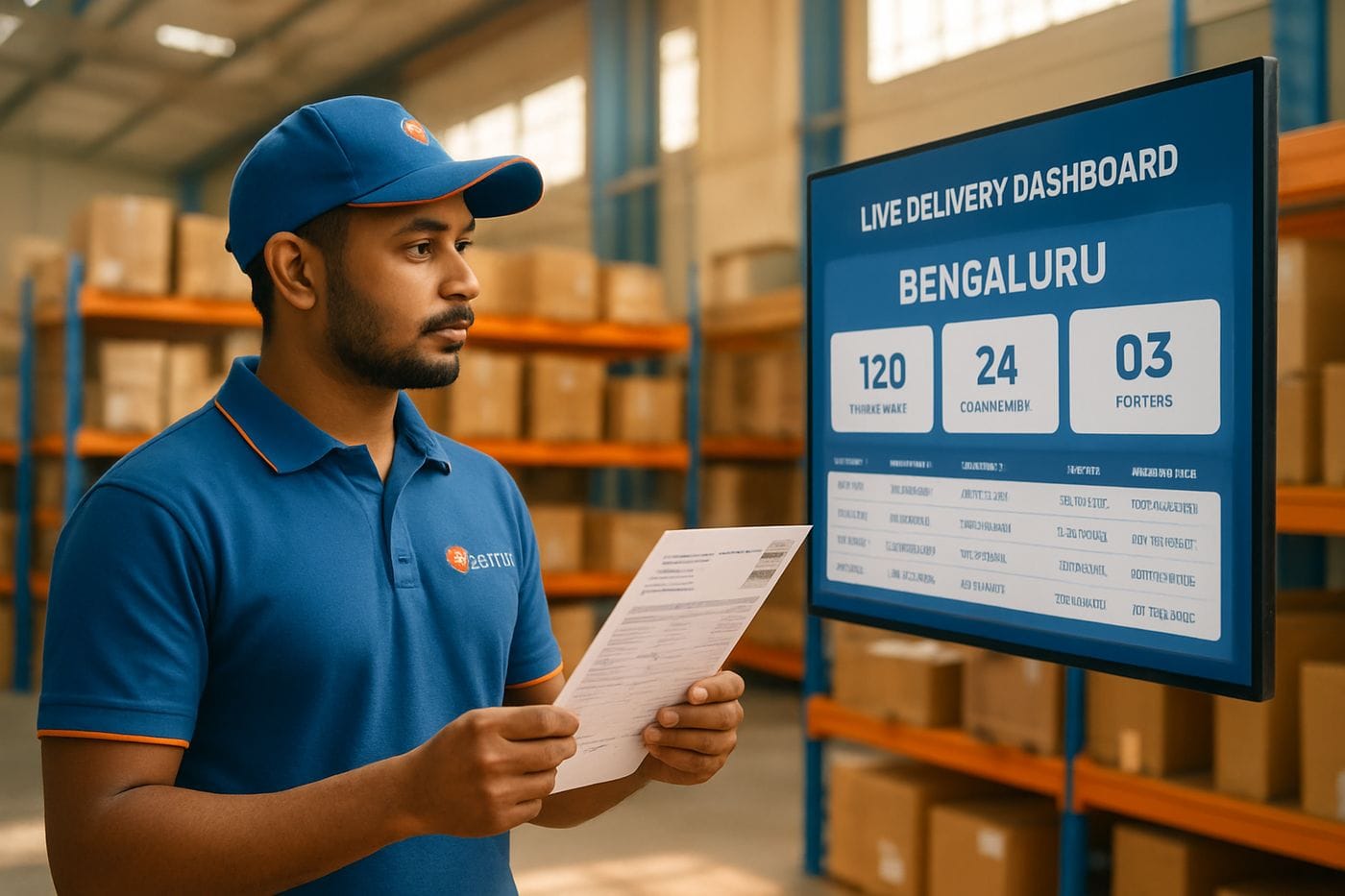
Delivery Hub combines internal fleet dispatch and multi-carrier shipping in a single dashboard. Warehouse teams assign own-fleet riders to local orders with auto-routing by zone, while the system simultaneously compares rates across Delhivery, BlueDart, DTDC, Ecom Express, FedEx, India Post, Porter, Shadowfax, FShip, DHL, and UPS to book the best option for outstation shipments. There is no toggling between portals.
Full COD Management Built for India
Delivery Hub handles the complete cash-on-delivery workflow. Drivers collect cash, record the amount in the Android or iOS driver app, and deposit at the store. The dashboard shows outstanding COD per driver, with deposit verification. Partial COD is also supported, so customers can pay part of the order value online and settle the rest in cash at the door. Risk-based COD controls automatically suppress COD for customers with a history of non-delivery and trigger auto-RTO after maximum delivery attempts, reducing return-to-origin losses.
India Post CEPT Integration with AWB Pool Management
For retailers shipping through India Post, Delivery Hub integrates directly with the CEPT system. Pre-allocated AWB number pools and manifest generation mean warehouse teams never have to visit an India Post portal. This is especially relevant for retailers in smaller towns where India Post is the primary outstation courier.
WhatsApp Notifications and Branded Tracking Pages
Every shipment dispatched through Delivery Hub generates a branded tracking page shared with the customer via link. Built-in WhatsApp templates send Out for Delivery and Order Delivered notifications automatically, using a QR-connected WhatsApp server session. Drivers can also message customers directly from the driver app via WhatsApp without exposing their personal numbers.
Real-Time Integration with the Commmerce Retail OS
Because Delivery Hub is part of the Commmerce Omnichannel Retail Operating System, orders flow from POS and the online store into the dispatch queue automatically via the Commmerce API Gateway and Shopify webhooks. Delivery status updates are pushed back to the POS and OMS in real time. Warehouse teams never need to manually copy order details between systems.
Multi-Language Support and Affordable Pricing
Delivery Hub ships with 13 Indian languages including Hindi, Tamil, Telugu, Marathi, Bengali, Kannada, and Gujarati, so driver apps work in the local language of every warehouse team. Pricing starts at Rs 4 per delivery plus a Rs 1,500/month minimum and Rs 500/month per driver for fleet management, with unlimited courier integrations included. Basic internal fleet setup goes live the same day, with carrier integrations typically completed in one to two days.
Proven at Scale: YourDesignStore
YourDesignStore (YDS), a print-on-demand retailer, handles more than 1 lakh shipments across domestic destinations and 90-plus international countries on Delivery Hub, combining own-fleet local delivery with multi-carrier outstation shipping. They use the multi-merchant panel to manage multiple brands with brand-wise tracking pages and label customisation. Risk-based COD controls have reduced RTO at YDS.
Running a retail business in India? See how Commmerce unifies your stores, inventory, orders and delivery in one platform.
Conclusion
Dispatch management software for Indian warehouse teams is no longer optional. As order volumes grow and customer expectations around delivery speed and transparency rise, stitching together carrier portals, Excel sheets, and WhatsApp threads simply does not scale. The right platform unifies own-fleet dispatch and multi-carrier shipping into one workflow, handles COD reconciliation end to end, supports Indian carriers and India Post out of the box, and integrates with the rest of the retail technology stack. Billing tools like Vyapar, Marg ERP, or TallyPrime solve the accounting side but leave the dispatch problem entirely unaddressed. For Indian retailers serious about operational efficiency in 2026, the move to a unified warehouse dispatch management system is one of the clearest wins available.
FAQs
Q: What is dispatch management software for warehouses?
A: Dispatch management software is a platform that helps warehouse teams assign orders to drivers or carriers, track shipments in real time, manage COD collection, and get proof of delivery, all from one dashboard instead of juggling multiple portals.
Q: Which dispatch management software works best for Indian retailers?
A: Indian retailers need dispatch management software that supports COD workflows, pincode-based zone mapping, and integration with Indian carriers like Delhivery and BlueDart, all features available in Commmerce Delivery Hub.
Q: Can dispatch management software handle both own fleet and third-party couriers?
A: Yes. Modern dispatch management platforms like Commmerce Delivery Hub let retailers manage their internal delivery riders and multiple courier integrations from a single dashboard, with automatic carrier rate comparison and assignment.
Q: How does COD management work in dispatch software?
A: In a COD-ready dispatch system, the driver collects cash at delivery, records the amount in the driver app, and deposits it at the store, while the dashboard shows outstanding COD per driver with deposit verification so no cash goes untracked.
Q: How quickly can an Indian retailer go live with dispatch management software?
A: With Commmerce Delivery Hub, basic internal fleet dispatch can be set up the same day, and carrier integrations with Delhivery, BlueDart, and other Indian couriers typically take one to two days depending on carrier onboarding requirements.
Disclaimer: This article is for general informational purposes only and does not constitute legal, financial, or tax advice. GST rules, compliance requirements, and platform features may change over time. Please verify the latest guidelines with a qualified professional or refer to official sources such as the GSTN or CBIC. Market statistics mentioned are based on publicly available estimates and may not reflect current figures. Commmerce product features referenced are accurate at the time of writing and subject to change.